
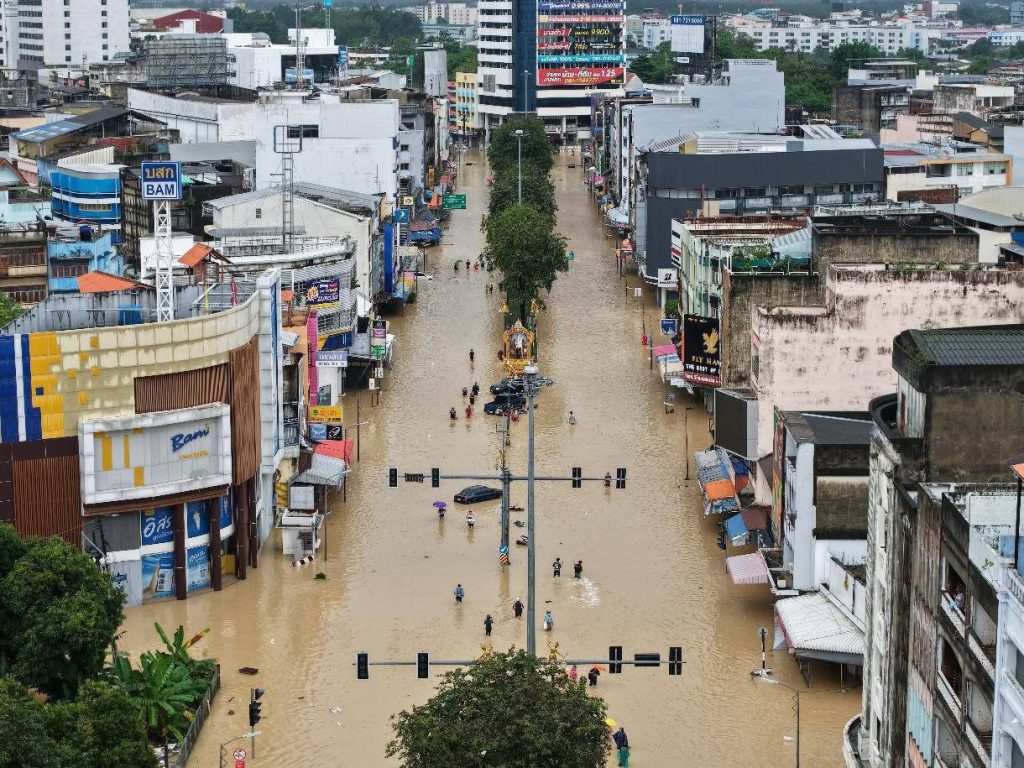
The government is being pressured to offer an apology to the pubic as its disaster management is heavily criticised as being sluggish and disintegrated in dealing with the situation
After being inundated with floods up to four or five metres deep for almost a week, the number of casualties and fatalities in southern provinces has emerged from the floodwaters. The flood death toll has now spiked to 145, surpassing those recorded in neighbouring countries, which have also been stricken by unusual Monsoon patterns and low-pressure areas over the same period of the past week or so.
The number is official and confirmed by the government’s Emergency Flood Response Operations Center this afternoon, covering flood deaths in eight southern provinces, with Songkhla reporting the highest number at 110.
The centre’s spokesperson, Siripong Angkasakulkiat, expressed regret on behalf of the government. He admitted the government’s flaws in handling the situation during the first days of the disaster, citing limitations in implementing proportional disaster management.
The spokesperson said that as the situation is entering a more controllable phase of recovery, it’s truly a time to prove whether his government is capable of dealing with disasters.
“In the end, we (the government) cannot deny responsibility. We tried to cope with the situation despite limitations. As you asked whether we made mistakes, we admit that we did and regret it,” said Mr. Siripong amid a growing call for the government to resign.

l The Emergency Flood Response Operations Center shares updates on the situation today. Credit: ThaiGov
Weather anomaly
Since the rainy season this year, Thailand has been facing unusual weather patterns, from La Nina and the increasing number of tropical storms and typhoons from the South China Sea that affected the North, Northeast, and the Central region, to the current unusual Monsoon patterns and low-pressure areas that have struck the South hard over the past week or so.
During the storm season, the country faced seven tropical storms in total, some of which had turned themselves into powerful typhoons before making landfall in coastal areas of neighbouring countries. The country normally faces only a few storms a year on average, meaning this year it has faced four times the average number of tropical storms.
The storms and La Niña brought excessive rainfall and run-offs, causing overflows in low-lying areas, especially in the lower northern and central regions. At the end of the season, marked by concerned agencies as November 1, the amount of water stored in 483 major and medium-sized dams nationwide was more than 76,500 million cubic meters, or 88% of the total storage capacity. At the end of the season, water is typically stored at around 80%, so that dams have some room to take in excess water from late rainfall.

Of 35 major dams, 21 held water of more than 80% of their storage capacity. Key major dams, especially Bhumibol and Sirikit dams in the North that help regulate the flows in the Chao Phraya River in the Central Plains, had already stored water at 95% and 97% of their storage capacity, respectively (around 22,000 million cu m combined), leaving very little room to store more water, according to the Royal Irrigation Department (RID).
The situation was further challenged critically by the last storm in the late season, which also turned into a typhoon, Kalmaegi. The typhoon had brought more rainwater and run-offs to the nearly full storage of those dams since it made landfall in Vietnam on November 6. This prompted the authorities to decide to discharge excess water downstream to ensure dam safety. The water discharge, in turn, exacerbated the flooding situation downstream, which still lingers in several areas in the central region until today.
As updated by GISTDA (Geo-Informatics and Space Technology Development Agency) on November 23, there are still floods in 9 central provinces, inundating 1.15 million rai and affecting more than 326,900 people. In several areas, the flood levels are still more than one meter deep.

The challenge then shifted to the South as the seasonal northeasterly Monsoon and low-pressure areas behaved abnormally and brought stationary heavy rainfall to the region. Different theories have been offered by climate experts and meteorologists to help explain the phenomenon, ranging from warmer water in the South China Sea fuelled by climate change, the so-called Atmospheric River, the rare Cyclone Senyar, which originated in the Straits of Malacca for the first time in history, its interaction with the seasonal weather systems, and others.
The result was stationary heavy rainfall hitting the record of a 300-year return period, inundating 10 southern provinces, including Songkhla and the region’s economic hub, Hat Yai district. According to the Disaster Prevention and Mitigation Department’s advisor, Assoc. Prof. Dr. Seree Supratid, the department had issued consecutive warnings of excessive rainfall from November 19 to 24 to local authorities.
On November 19, the Thai Meteorological Department (TMD) reported the highest rainfall in Songkhla, registered at 296.9 millimetres. And over the first three days, November 19-21, the cumulative rainfall was already 630 mm, far exceeding the last major flooding in Hat Yai in 2010, which was measured at 428 mm.
But it was not until November 21 that the Hat Yai municipality decided to raise a red flag to warn city residents to evacuate. By that time, the city was hit by the 300-year rainfall, being measured at 335 mm, according to the RID’s Smart Water Operation Center.
This was only a day before Prime Minister Anutin Charnvirakul paid a visit to the province to inspect the situation and made a critical decision, which was later criticised heavily as being sluggish and disintegrated in dealing with the disaster.
The flaws exposed
On November 22, or last Saturday, PM Anutin paid a visit to Songkhla while the province and its economic hub were battered with torrential rainfall.
He was briefed about the situation by Songkhla Governor Ratthsart Chidchoo during their meeting with officials concerned. The governor, who was a commander of the provincial command center, told him that the province had already decided to lift a red flag for residents in all 103 communities in Hat Yai municipality, signalling a mass evacuation for the city. This was because the city was threatened by the flooding, which had already surpassed the records in 2000 and 2010, the governor said. The cumulative rainfall during November 19-22 reported to the governor stood at 595 mm, close to the RID SWOC’s measurement.
In total, all 16 districts of the province had been affected, and 14 of them were still dealing with the situation. Three of those districts, including Hat Yai, were in the most critical situation and were still under watch, the governor briefed the PM.
PM Anutin spent another day inspecting the situation in the province, particularly the temporary shelters set up in the city. He remained positive, giving an interview during his inspection in which he said the flood levels were expected to recede in the next three or four days before flying back to Bangkok.
Unfortunately, the situation did not turn out as he had projected.


l PM Anutin and Songkhla governor during their inspection in the city of Hat Yai on Nov 23. Credit: PR Songkhla
The frustration
According to Songkhla Governor, the situation since November 19 had slightly eased on November 23, but in the late night, water run-offs outside the city began flowing into the city through its water discharge systems and overflows.
Realising the escalating situation, the governor in the late morning of November 24 issued an order to the residents in the city’s inner areas, which were prone to high-level floods the most to evacuate immediately. He projected that the flood levels in the city would rise in the evening to the point that they could impede the evacuation.
“I ask you to leave your areas now so our rescue efforts and handling of the situation could be most efficient,” declared the governor later in the afternoon, while admitting that as the night was drawing in, the rescue efforts could become difficult.
By then, rainfall in the province had reached 359.6 mm, the highest in the region, according to the TMD.


l Credit: GISTDA
In Bangkok on the same day, November 24, PM Anutin called for a meeting of the national committee for disaster management. He decided to exercise his power under the State Administration Act B.E. 2534 to appoint his Deputy Prime Minister and Minister of Agriculture, Capt. Thammanat Phromphao, to be in charge of a newly set up operation centre to rescue flood victims.
A day later, on November 25, he again issued a drastic order under the Emergency Decree to declare a serious emergency situation in the entire Songkhla province and appointed the Commander in Chief to be in charge of the situation there.
But in the late evening, PM Anutin once again exercised his power under the Disaster Prevention and Mitigation Act B.E. 2550, declaring the disaster in Songkhla as level 4, meaning critically serious. This prompted him, in his capacity as Prime Minister, to take charge of the situation while the national single command was set up alongside.
Afterwards, other orders were issued under these different laws, including the establishment of the Emergency Flood Response Operations Centre, further causing public frustration across the government’s various lines of command.


l The situation during its peak in Hat Yai and nearby districts. Courtesy of PR Songkhla
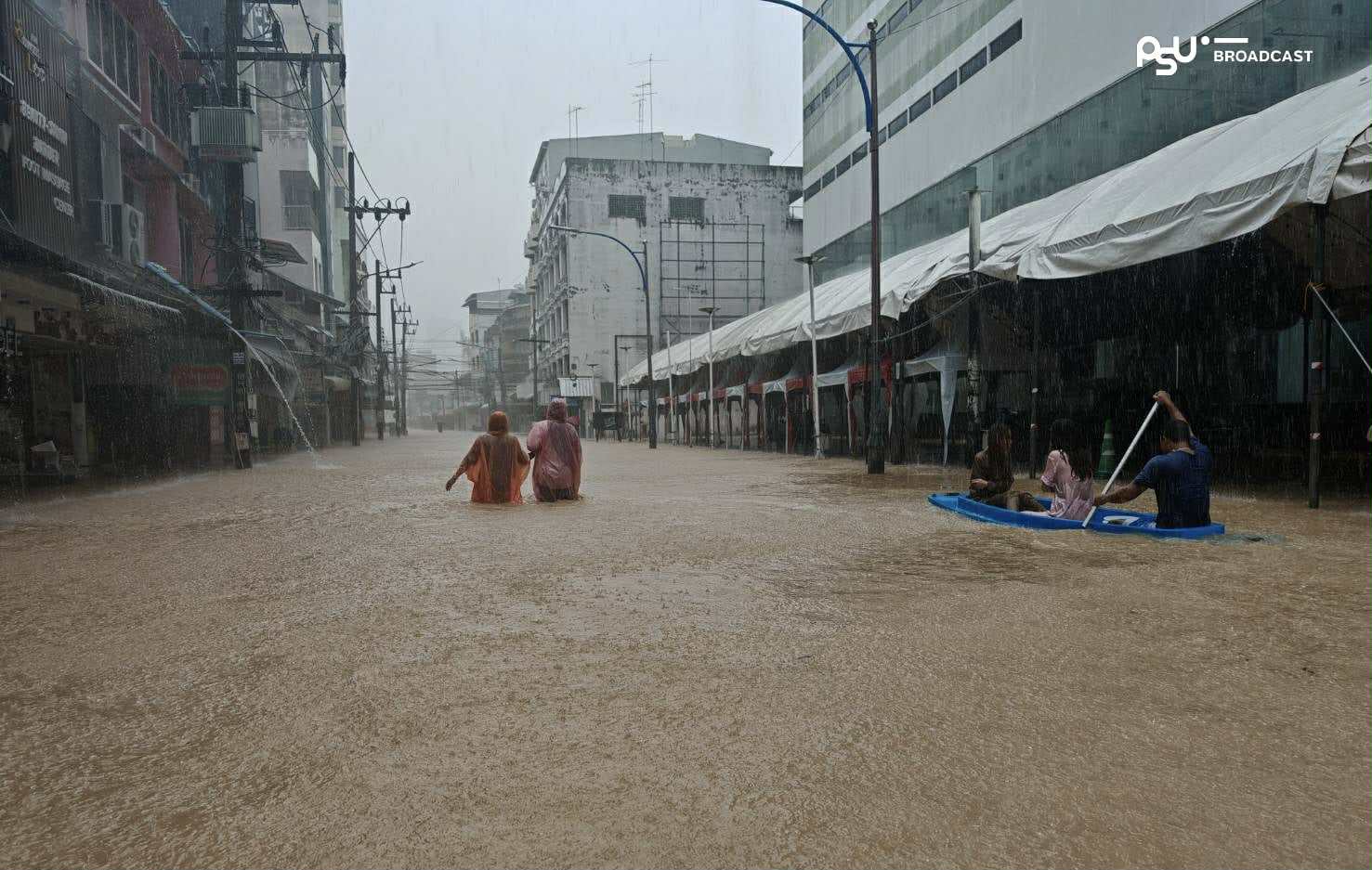
By then, Songkhla province and its business centre, Hat Yai, were submerged under floodwaters up to four or five meters deep, and a great number of the city’s residents were left in despair as they could not escape the disaster in time.
In Hat Yai alone, the floods on November 24 already submerged over 50,000 rai of the residential areas, affecting more than 25,000 households and 150,000 residents, according to GISTDA. The agency also revealed that during November 24-26, more than 300,000 AIS phone numbers were still active in the flooded areas in the city, suggesting that a great number of the city residents may not have been evacuated and still remained in the flooded areas.
As of November 26, when the situation began to ease with less rainfall, the DDPM reported that severe flooding had affected more than 320,800 households across all 16 districts in Songkhla.
But it’s not just Songkhla and its business centre, which were severely affected. Eight other southern provinces, from Surat Thani down to Narathiwat, also bore the brunt. In all, up to 101 districts, 683 subdistricts, 5,127 villages, over 986,000 households, and 2.73 million residents in those provinces were affected by the same disaster, as recorded on November 26 by the DDPM.
Also read: Rescuers step up recovery operations as Southeast Asia flood deaths reach 321

Indie • in-depth online news agency
to “bridge the gap” and “connect the dots” with critical and constructive minds on development and environmental policies in Thailand and the Mekong region; to deliver meaningful messages and create the big picture critical to public understanding and decision-making, thus truly being the public’s critical voice