
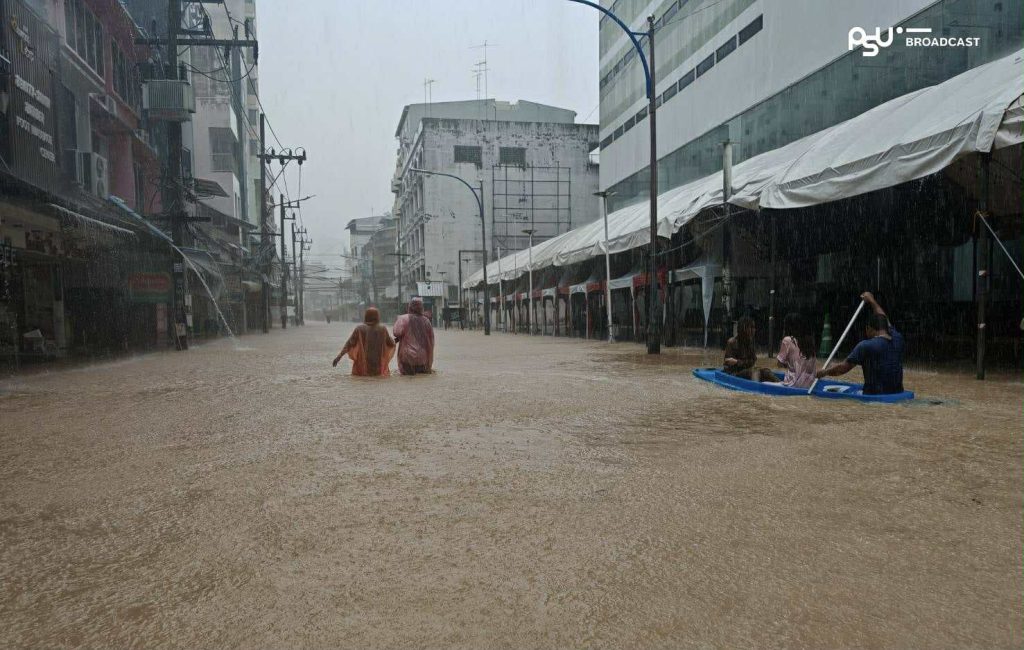
As of December 1, the official flood death toll in southern Thailand rose to 175, while discrepancies persist between government and charity sources. Charities estimate deaths could exceed a thousand, citing rescuers’ rough counts.
The flood death toll and devastation in the south reflect a new scale of calamity for the country. They are also a strong testament to how poor and fragile our disaster management and governance are in dealing with the growing threat posed by natural disasters — especially those driven by climate change.
During the rainy season, the country faced at least seven tropical storms in the South China Sea, some of which intensified into typhoons before landfall. This is nearly four times the country’s average number of tropical storms.
The arrival of these storms stretched the water management infrastructure, with almost 90% of the facilities storing excessive rainwater this year. Some major dams, including Bhumibol and Sirikit, even saw their water storage filled up at almost 100% and 95% to 97%, respectively, leaving very little room to hold more water.
The late-season Typhoon Kalmaegi and unusual northeasterly Monsoon and low-pressure patterns further pressured infrastructure, forcing the government to discharge excessive water downstream. This prolonged flooding and wreaked havoc on downstream communities in the Central Plains, which are still underwater today.
While the government narrowly escaped public criticism for its mishandling of the flooding situation in the central region, it can no longer avoid the blame, which has laid bare the country’s flaws in disaster management and governance.
Following unusual monsoon patterns, low-pressure areas, and a severe cyclone in the Strait of Malacca, the South is the next victim of weather anomalies and poor disaster management. Since mid-November, the region has faced torrential rains and severe flooding, with rainfall reaching a 300-year return period on some days.
Despite extensive warnings issued by the Disaster Prevention and Mitigation Department via its new Cell Broadcast system, many people in the nine southern provinces, especially in Songkhla and its business centre, Hat Yai, were not spared from the severe flooding.
This has led to a big question: why?
As the water receded, flaws in disaster management emerged. The public later learned that Prime Minister Anutin Charnvirakul, acting as the highest commander under the Disaster Prevention and Mitigation Act B.E. 2550, was present at the peak of Hat Yai’s flooding on November 22-23, inspecting conditions and receiving reports from provincial commanders (Levels 1 and 2) about the escalating threat. Rainfall from November 19-22 totalled 595 mm, already surpassing major flood records from 2000 and 2010.
Instead of taking charge of the situation, PM Anutin, who was also the Level 3 Commander under the act in his capacity as the Interior Minister, simply left his commanders in the province to handle it. PM Anutin further frustrated the public and his personnel by endorsing different lines of command under different laws, including the Emergency Decree — except for those under the direct disaster act.
It was not until December 25 evening that he decided to invoke his absolute authority under the act to take charge of the situation, which, by far, was too late, as tens of thousands were left stranded in their flooded houses and on rain-soaked rooftops.
By then, absolute power could not improve matters. Disaster management had become disintegrated and sluggish, worsened by “business as usual” bureaucracy. Few unified protocols or adequate logistics supported rapid response and rescue. Nor was there timely disaster relief or reparation — all of which led to real disaster for the government.
If anything can be defined in one phrase to describe this, it’s the absence of disaster risk governance, with almost all elements — from accountability to efficiency — missing.
As the water has receded and the flaws are clear to our sight, it is time for the government, if not more, to revise and restore the disaster management system and governance. Given the great suffering that happened, the country cannot afford the failed and fragile system any longer.
Also read: Death toll in southern floods spikes to 145 as disaster management flaws exposed

Indie • in-depth online news agency
to “bridge the gap” and “connect the dots” with critical and constructive minds on development and environmental policies in Thailand and the Mekong region; to deliver meaningful messages and create the big picture critical to public understanding and decision-making, thus truly being the public’s critical voice