
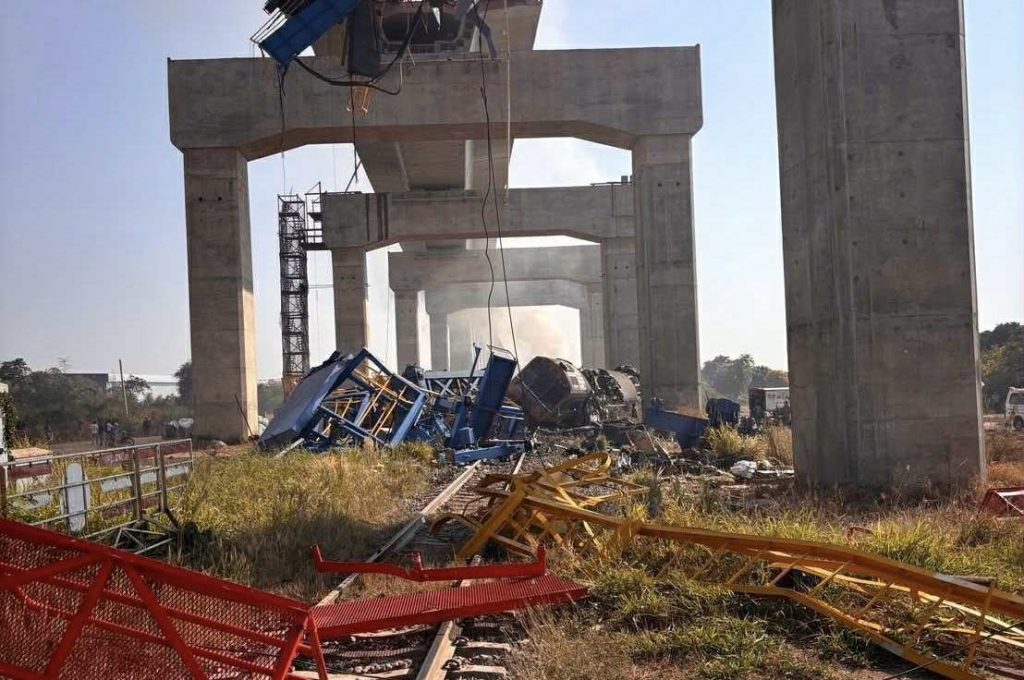
The incident has once again raised questions about flaws in construction standards, as it was found that the company involved in the collapse of the State Audit Office building last March, Italian-Thai Development Plc (ITD), is responsible for the construction project
As of 6.30 pm yesterday, the Ministry of Public Health reported that 32 passengers were killed in the incident, three are still missing, and 64 were injured. Of 64, seven are in a serious condition, 19 were moderately injured, and 38 were slightly injured. They were transferred to nearby hospitals, and 11 of them were reported to be staying there.
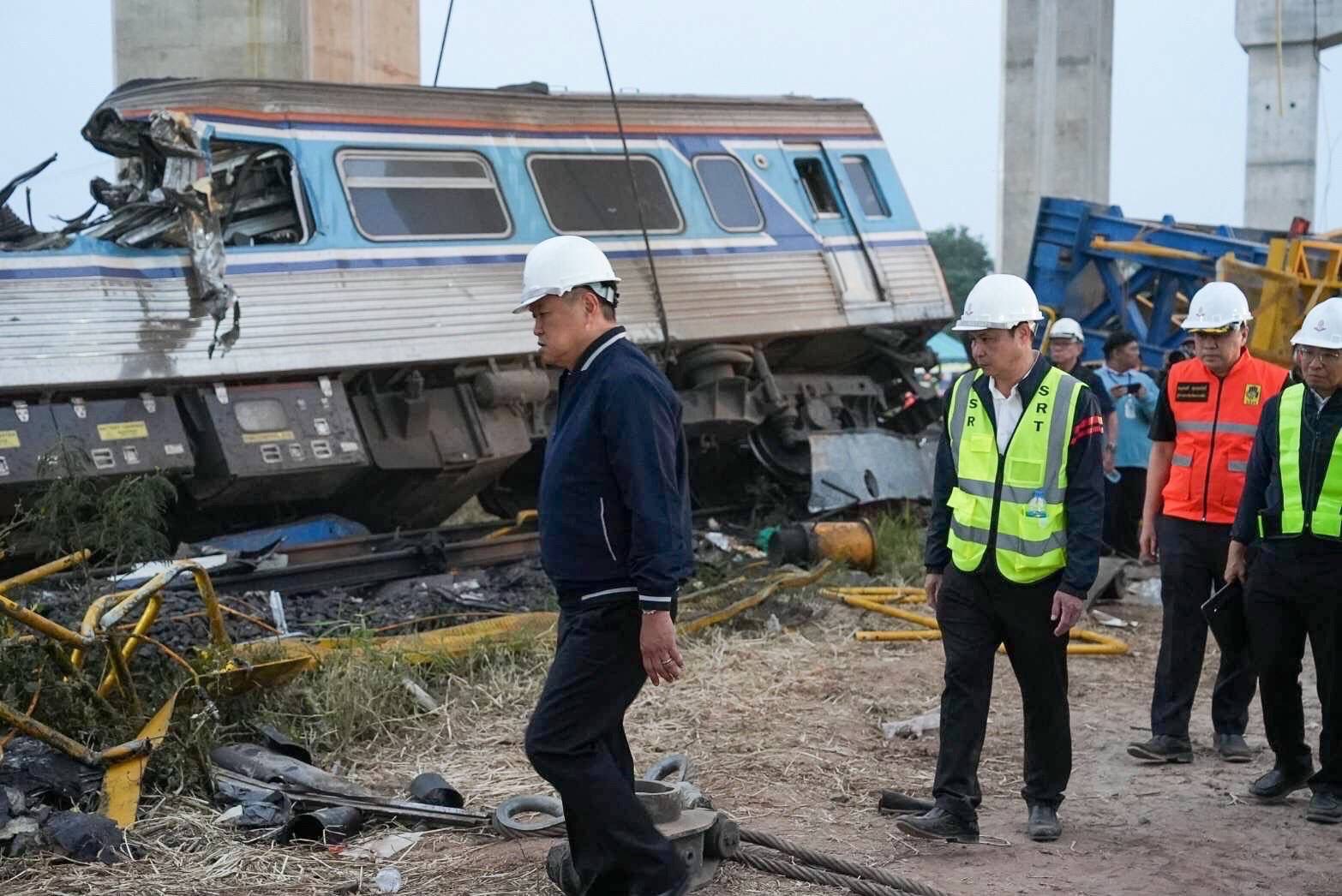
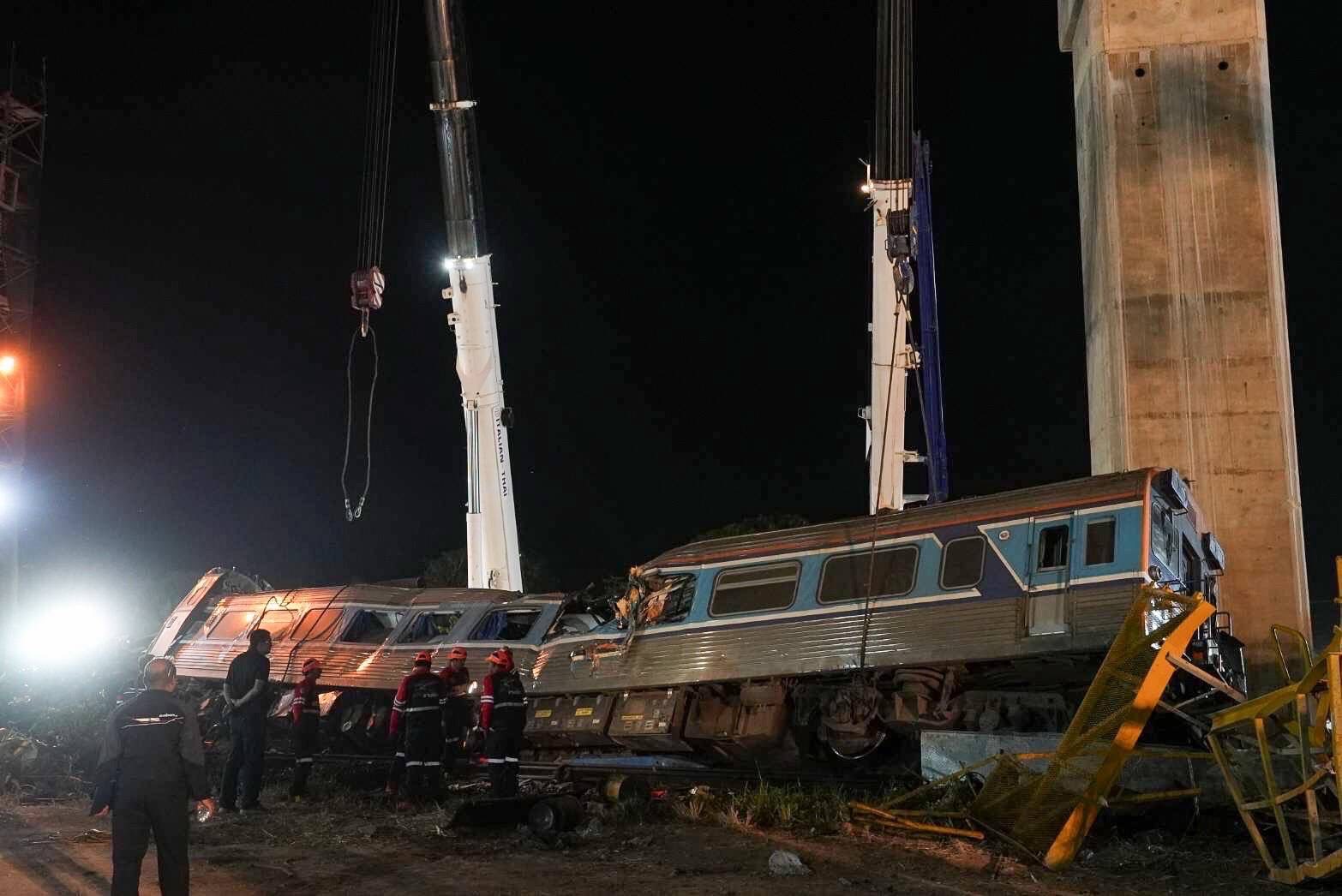
According to the State Railway of Thailand (SRT), the crane, operated by a contractor for the Thai–Chinese High-Speed Rail project (Contract 3–4), fell onto Special Express Train No. 21 around 9 am while it was travelling between Nong Nam Khun Station and Sikhio Station in Sikhio District, northeastern Nakhon Ratchasima province, or Korat.
The crane, which was on the under-construction high-speed railway, fell onto two carriages of the train. The collapse caused the coaches to derail and catch fire, according to the SRT executives.
Acting SRT governor, Anan Phonimdaeng, said he has set up a fact-finding panel and instructed it to investigate and report the causes of the incident to him within 15 days. The SRT will also take legal action against those responsible for the incident, he said.
So far, he has ordered the contractor to suspend work at the site pending the investigation, the acting governor said.
PM Anutin Charnvirakul also vowed to find the culprits. He has called for those responsible for the incident to be held accountable. The PM questioned why the contractor on the project hasn’t been blacklisted despite the recurrence of similar accidents, the collapse of the SAO building included.
He further cited previous incidents, including the collapse of a tunnel at another site, noting that it isn’t just a technical failure but a serious violation of public safety, and stressed the need for stricter safety measures and accountability, including amendments to the law.
Later in the day, Italian-Thai Development Plc issued a statement expressing deep regret and said it will take responsibility for the losses in the incident.
The BRI project
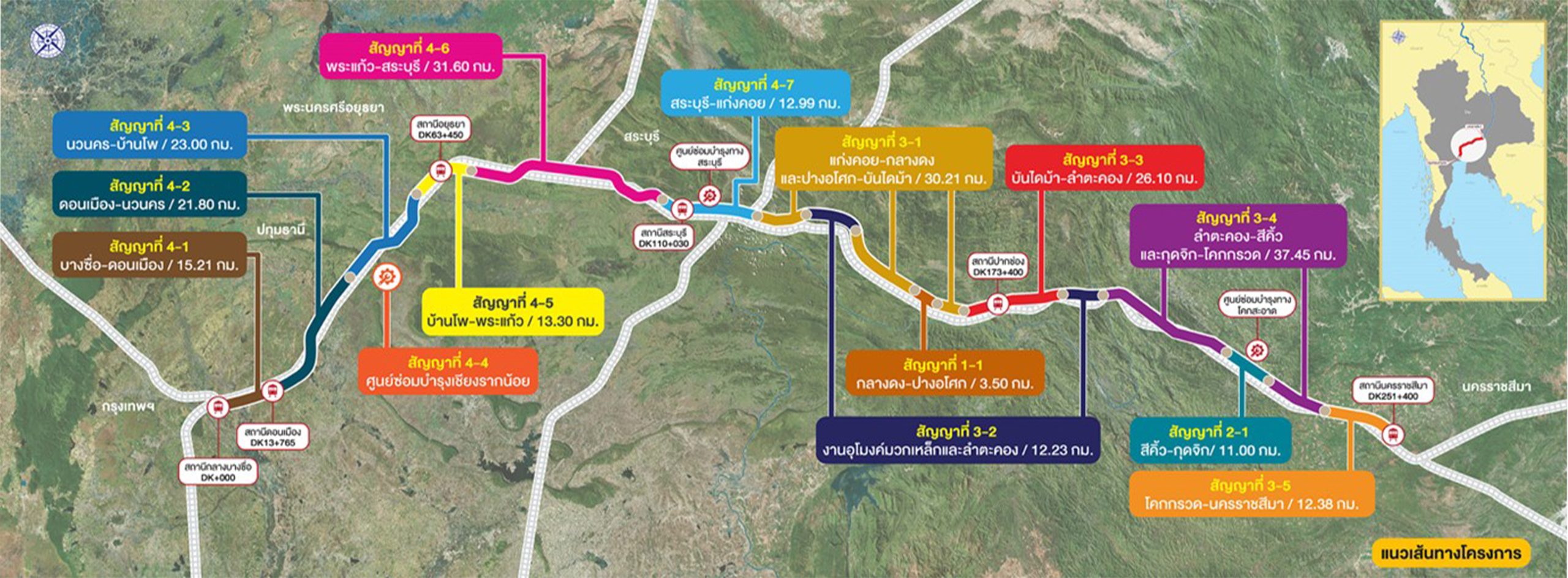
The Thai–Chinese High-Speed Rail project (Contract 3-4) is part of the 250-km Bangkok–Nakhon Ratchasima section (Section 1) of the 873-km Bangkok–Nong Khai HSR Development for Regional Connectivity project.
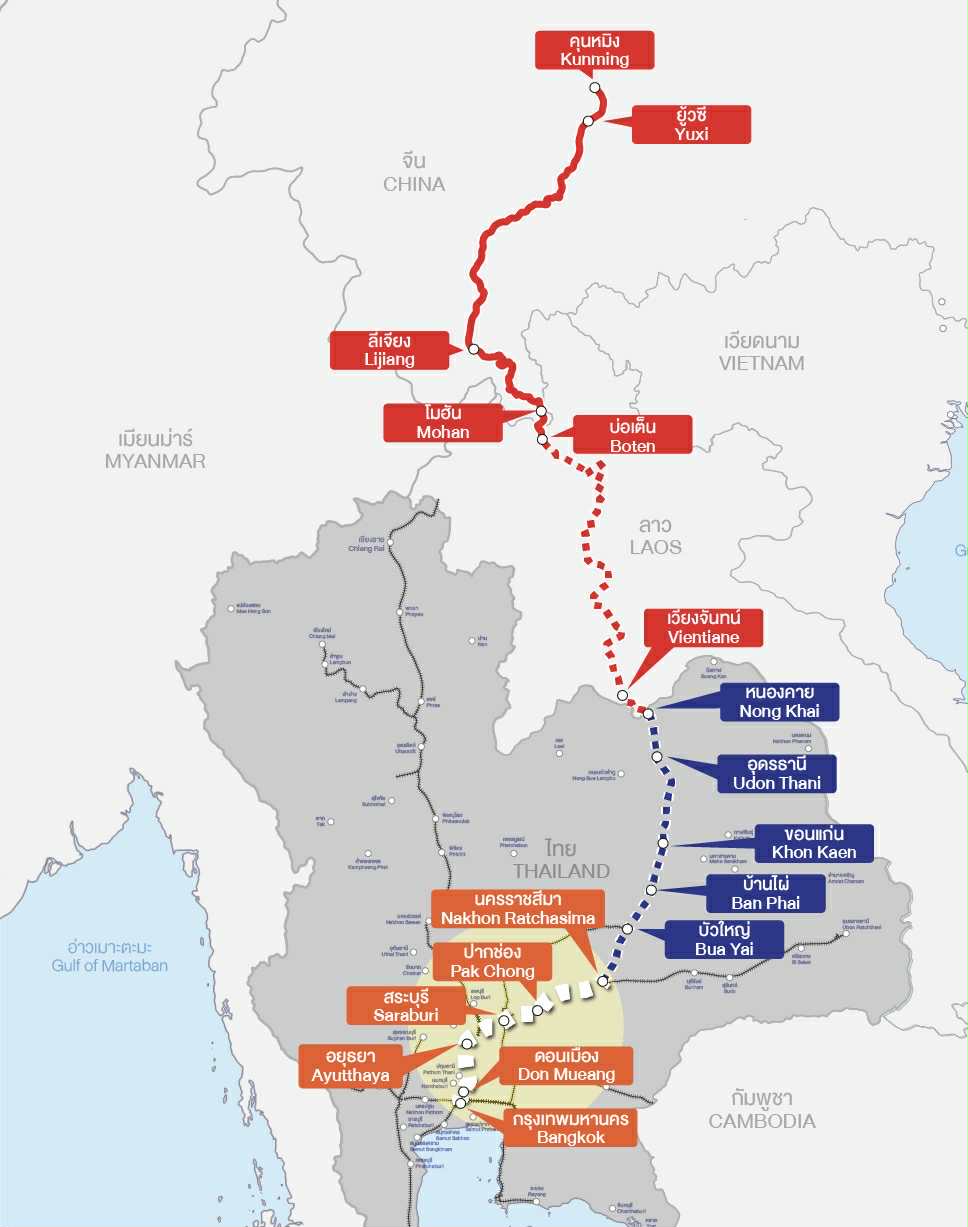
According to SRT, the Bangkok–Nong Khai HSR Development project is a strategic project regarding ASEAN regional connectivity to develop a linkage route between Thailand and other countries, both regionally and globally, in congruence with the Belt and Road Initiative (BRI) by the government of the People’s Republic of China.
“The project is an international joint development at the government level between Thailand and China. In this regard, the Thai government is responsible for the entire project investment, civil works construction, and application of Chinese construction technologies and railway systems,” the SRT said on the project’s website.
On December 19, 2013, the Memorandum of Understanding (MoU) on Thai railway infrastructure development, in line with Thailand’s Transport Infrastructure Development Strategy 2015-2022, was signed.
The SRT said this was to enhance connectivity between Bangkok, Thailand; Vientiane, Laos; and Kunming, the capital of Yunnan Province, China, to support seamless integration with the Chinese HSR network, as well as the future extension of the Thai HSR from Bangkok to Malaysia and Singapore.
At the 10th joint committee meeting in Beijing on railway cooperation between Thailand and China on May 12, 2016, both parties agreed to commence the project by constructing the Bangkok-Nakhon Ratchasima railway route.
On July 11, 2017, the Thai Cabinet approved the Project on Bangkok-Nong Khai HSR Development for Regional Connectivity (Section 1: Bangkok-Nakhon Ratchasima). Its commencement ceremony was held on December 21, 2017, with a total budget of 179,412.21 million baht. According to the SRT, the project is under construction and expected to start operation in 2027.
As of November 25, 2025, the overall work progress is 50.2% completed.
The Contract 3-4
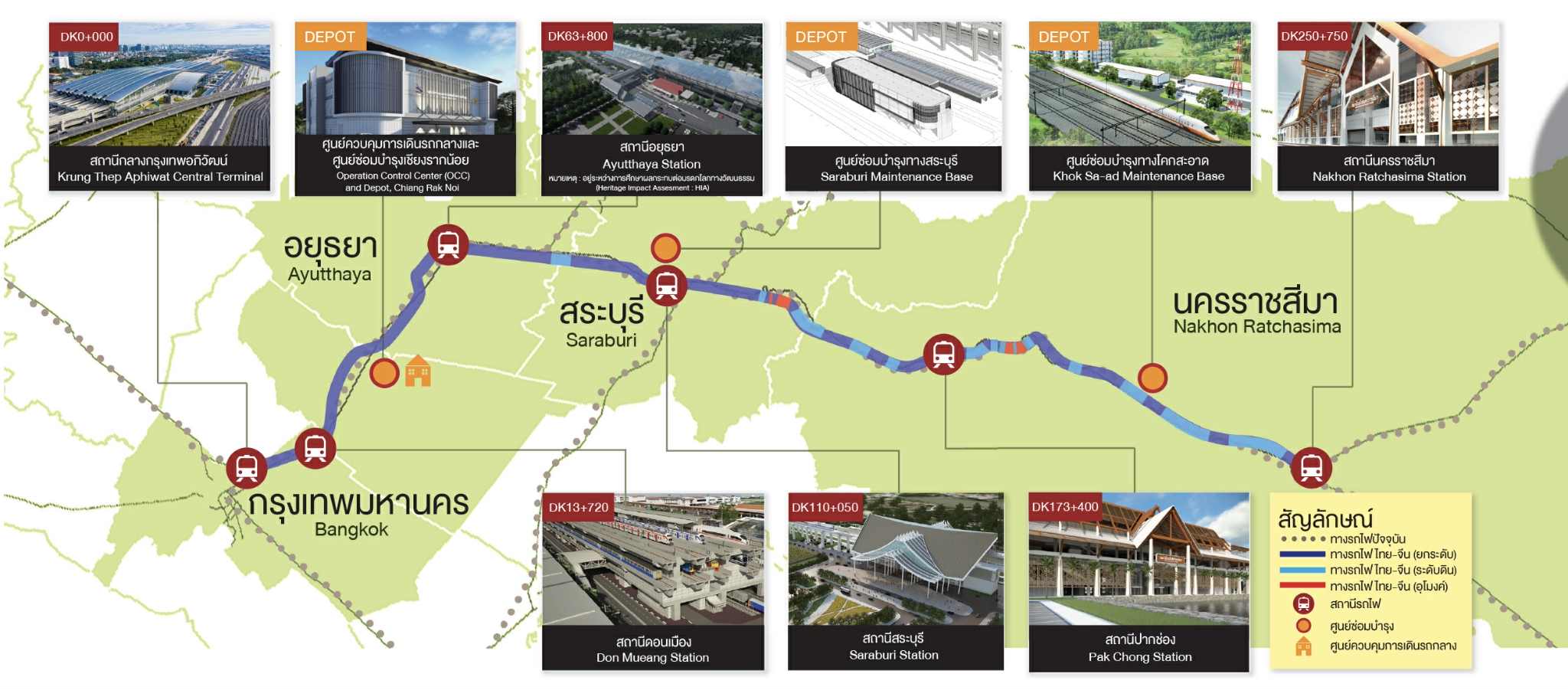
According to the SRT, the Bangkok–Nakhon Ratchasima section totals 250.77 km. It is divided into an elevated route, 188.68 km, an at-grade route, 54.09 km, 2 tunnels, one in Muak Lek District and the other at Lam Takong Reservoir, 8 km. There will also be six stations along the route: Krung Thep Aphiwat Central Terminal, Don Mueang Station, Ayutthaya Station, Saraburi Station, Pak Chong Station, and Nakhon Ratchasima Station.
The section is currently under construction. It consists of 15 contracts: 14 for civil works construction and one for the railway system and the procurement and supply of rolling stock. The ITD’s Contract 3-4 is among those 14 contracts.
The ITD’s Contract 3-4 covers the distances between LamTakhong to Sikhio Section and Kut Chik to Khuak Kruat Section, totalling around 37.5 km. The company reported work progress of 99.45% as of November 25, 2025.
The ITD also has another two contracts: Contract 4-4 (Chiang Rak Noi Depot), and Contract 3-1 with its joint venture counterpart, CREC No.10 (ITD-CREC No.10), covering Kaeng Khoi-Klang Dong Section and Pang Asok-Bandai Ma Section with a total distance of 30.21 km. The joint venture reported the work progress in this contract at 24.35%.
China Railway Group
CREC No.10 was identified as the largest shareholder in another company that formed a joint venture with the ITD to construct the SAO building, which collapsed in the major earthquake last March. China Railway Number 10 (Thailand) or CREC. It’s the only building in Bangkok that completely collapsed during the disaster, prompting a serious investigation into flaws in construction standards.
Its representative, Mr. Zhang Chuanling, was arrested by the Department of Special Investigation for his role in the use of nominees in the CREC. In mid-2023, he had represented CREC No.10 in a contract signing ceremony of the Contract 3-1.
Bangkok Tribune ever checked the relationships between these companies during the case of the SAO building collapse and learned that CREC No.10 is a subsidiary of China Railway Group Limited (CREC, the same abbreviation as China Railway No.10 (Thailand)), China’s super-large state enterprise, which claims to have been listed among Fortune Global 500 for 17 consecutive years. In 2022, it ranked 34th on the Fortune Global 500 list and 5th among China’s top 500 enterprises. (Read: China Railway Number 10 (Thailand)’s boss under arrest)
According to its business structure, CREC No.10 is a subsidiary of CREC’s Infrastructure Construction unit. Under the same unit, there are several other China Railway Engineering Groups with Numbers tagged. In addition to the infrastructure construction unit, CREC also has units for engineering design and consulting, overseas projects, equipment manufacturing, featured properties, mineral resources development, finance and trends, asset management, and other areas.
China Railway International Co., Ltd. and China Railway Design Corporation are found to be the construction supervision consultant of the Secion 1: Bangkok-Nakhon Ratchasima. They are also found to be the subsidiaries of the CREC.
Also read stories about the BRI at BRI’s Laos-China Railway: A new dawn for Greater Mekong?/ Boten: the “Resurrection” of the Ghost Town/ The China-built railway cutting through Laos

Indie • in-depth online news agency
to “bridge the gap” and “connect the dots” with critical and constructive minds on development and environmental policies in Thailand and the Mekong region; to deliver meaningful messages and create the big picture critical to public understanding and decision-making, thus truly being the public’s critical voice