
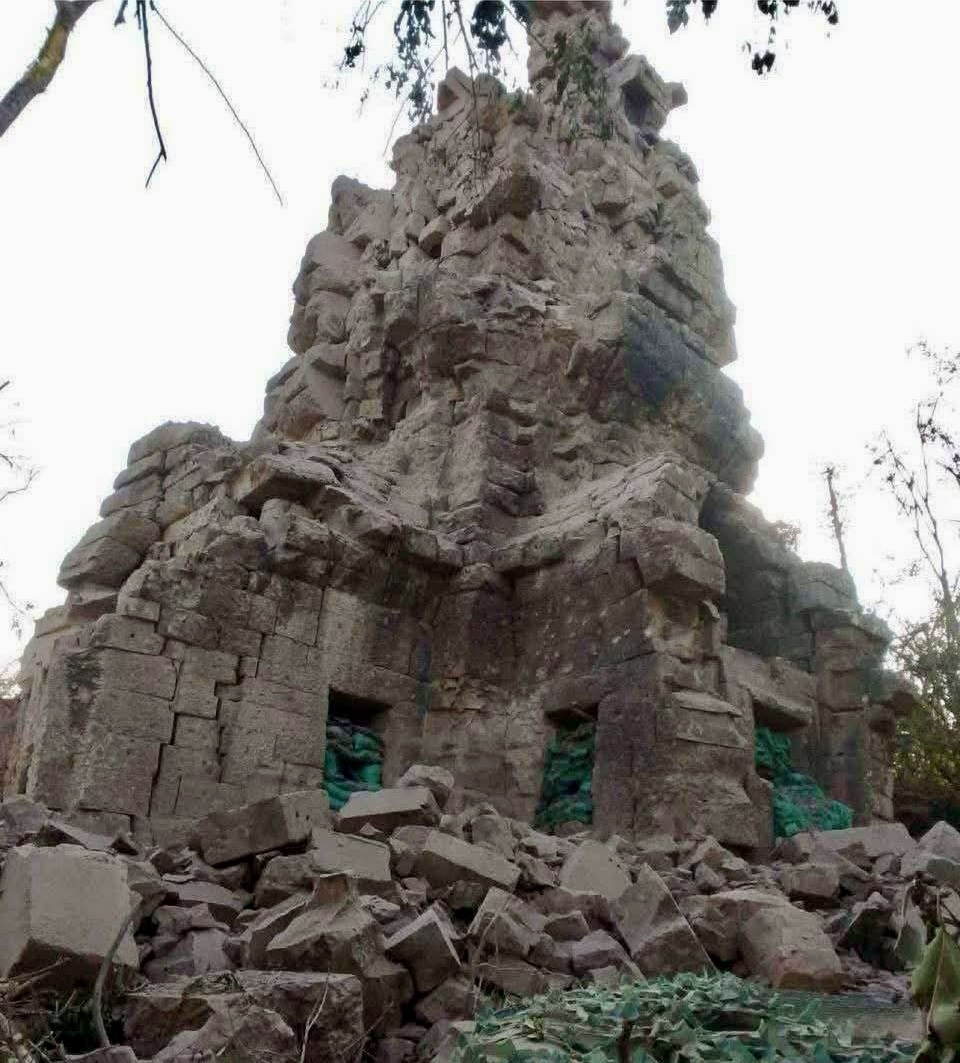
The Fine Arts Department has expressed its views regarding damage to some heritage sites during the renewed border clashes between Thailand and Cambodia, emphasising that no heritage sites in the world should be damaged by war
The Thai Fine Arts Department’s Chief, Phnombootra Chandrajoti, said this morning at the press briefing that no heritage sites in the world should be damaged by war, and that’s the reason why the international community has come up with rules and principles to prevent the use of heritage sites as military bases or for military operations.
At the ancient temple of Ta Kwai, where Cambodian troops had laid siege during the first round of fighting in late July, the chief noted that some evidence suggested Cambodian forces have positioned themselves at the temple and converted it into a military base. This, he said, violates international law governing the protection and preservation of cultural heritage sites.
Their actions have drawn risks to the site during the fighting with Thai troops, as it’s prone to the use of forces and weapons by both sides, he added.
Regarding the damage done, the Fine Arts Chief said the temple and other sites damaged during the fighting can be restored. The department has the expertise and technology to repair sites within Thai territory; therefore, the territory must be reclaimed first,” he further said, citing past work at Phanom Rung Historical Park, Phimai Historical Park, and Prasat Sdok Kok Thom.
Ta Kwai Temple is just one of several cultural heritage sites along the Thai-Cambodian border, which are prone to damage during the fighting between Thai and Cambodian troops.
Last week, both sides accused each other of damaging the properties. Cambodia’s Ministry of Culture and Fine Arts claimed that Ta Kwai, or Ta Krabey in Cambodia, and Phraeh Vihear had suffered from heavy destruction from the Thai military attacks on Dec 8-9. Ta Kwai was shelled again on December 10, after which the ministry claimed the shelling had completely devastated its appearance and architectural structure.
The Royal Thai Army, meanwhile, responded to the Cambodian ministry’s statement, saying it was Cambodia which intentionally used the historical site for military operations as a base to attack Thailand and deliberately undermined the protection of the historical site. Thailand, therefore, retaliated as necessary.
The RTA’s spokesperson, Major Gen. Winthai Suvari, clarified the issue, saying Thailand adheres to the 1954 Hague Convention, which in the event of armed conflict stipulates that historical sites must be protected and prohibits attacks or any actions that may cause damage.
However, the Convention provides explicit exceptions if historical sites are used for military purposes, such as establishing bases, controlling operations, serving as sniper positions, or preparing for attacks. In such cases, the areas may temporarily lose their legal protections during military operations, Major Gen. Winthai stated.
When the Cambodian side intended to use the ancient site as a military base of operations, including deploying surveillance and weapons systems to attack Thailand, the area fell under the Hague Convention’s “temporarily lost protection” category, he further noted.
In the case of Ta Kwai and Preah Vihear Temple areas, the Cambodian side has used them for military operations, placing weapons systems, ammunition depots, explosives, and landmines for attacks against Thailand. Evidence of this is widely available on social media, he added.
“Therefore, it should be considered that Cambodia itself is the one that has violated humanitarian laws and international conventions, and that it fails to value its cultural heritage. Thailand, therefore, has the legitimate right to defend against those threats appropriately and proportionally, in accordance with international rules and as necessary, given the coercion from Cambodia,” said the RTA’s spokesperson.
As of today, Thailand has managed to reclaim Ta Kwai Temple, according to the Thai Army. Its severe damage is clearly visible, as shown in some photos circulated on social media.
Earlier, UNESCO also expressed strong concern over the same issue at the Preah Vihear Temple, a UNESCO World Heritage site. The world’s cultural promotion and protection organisation had called for urgent protection of the region’s cultural heritage in all its forms in its statement issued last week.
The organisation said it had reminded all parties of their obligations and commitment to respect international law, notably the 1954 Hague Convention for the Protection of Cultural Property in the Event of Armed Conflict and the 1972 Convention concerning the Protection of the World Cultural and Natural Heritage.
UNESCO said it has communicated the geographical coordinates of sites on the World Heritage List, as well as those of sites of national significance, to all parties concerned to prevent potential damage.
The organisation said it will continue to monitor the situation of cultural heritage in the region to ensure its protection, and stand ready to provide the necessary technical assistance to safeguard cultural property and implement any essential safeguarding measures as soon as conditions allow.

Indie • in-depth online news agency
to “bridge the gap” and “connect the dots” with critical and constructive minds on development and environmental policies in Thailand and the Mekong region; to deliver meaningful messages and create the big picture critical to public understanding and decision-making, thus truly being the public’s critical voice