
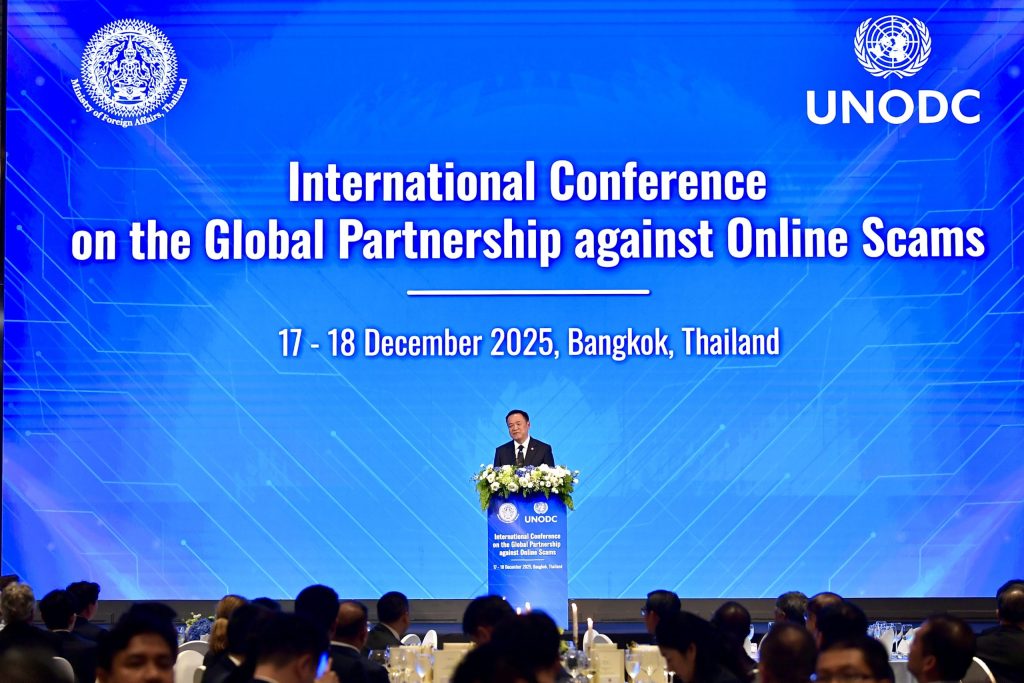
The two-day international conference, “The Global Partnership against Online Scams”, co-hosted by Thailand’s Ministry of Foreign Affairs and the United Nations Office on Drugs and Crime (UNODC), was wrapped up yesterday with a consensus on the acceleration of practical cooperation to keep pace with this evolving form of crime and the adoption of the 2025 Bangkok Joint Statement
As explained by the MFA, the conference is a follow-up to the announcement by Thai Prime Minister Anutin Charnvirakul at the 47th ASEAN Summit in October in Kuala Lumpur, Malaysia. The conference has also come at a time when the Thai troops are also focusing on suppressing the supporting facilities of these illicit activities along the Thai-Cambodian border during the renewed fighting with Cambodia.
According to the MAF, the conference aimed to build on and complement existing regional and international efforts to combat online scams and to promote international cooperation to close “practical operational gaps”.
In addition to the high-level segment, two thematic discussions were held at the conference. One focused on assurance of justice, from investigation to prosecution. The other focused on tracking illicit financial flows and addressing technology-enabled crimes.
The MFA said online scams are a complex form of transnational crime that affects many countries. Therefore, it requires a Global Partnership of concerted efforts across countries and sectors to address the scale of this problem.
The Conference brought together over 300 participants from 60 countries, as well as international organisations, the private sector and civil society. Also attending were Ministerial-level representatives and senior officials from many countries, including China, India, Indonesia, Myanmar, the Lao PDR, Viet Nam and Rwanda.
At the opening ceremony, Minister of Foreign Affairs H.E. Sihasak Phuangketkeow delivered opening remarks underscoring the need to enhance global cooperation to tackle online scams, which he said are occurring at an “industrial scale” across borders. They link to other crimes, including forced labour and human trafficking, and therefore, there is a need for practical cooperation and integration of work to suppress them.
The UNODC Regional Representative for Southeast Asia and the Pacific also delivered remarks, underscoring that online scams are a serious problem, causing significant economic losses and driving other forms of crime, including human trafficking, cybercrime, and money laundering.
The UNODC was ready to continue supporting the Global Partnership’s efforts, she said.
Representatives of attending agencies and offices, including the European Union (EU), also shared their views following the conference.
The EU noted in its latest post on the FB Page that scam networks operate without borders, so the response must do the same. The major bloc further pointed out that the fight against online scams is a shared responsibility. By working together across regions, sectors and institutions, they can protect citizens, uphold trust in the digital economy, and safeguard the integrity of societies.
“We see Southeast Asia as a key partner for shaping solutions that can have a global impact to promote a secure, inclusive and rules-based digital environment,” said Chargée d’Affaires a.i. of the EU Delegation to Thailand, Sara Rezoagli.
Europol’s latest threat assessments confirm that online fraud is now among the fastest-growing forms of organised crime. Europe is holistically leveraging its internal security strategy called “Protect EU”, and EU-funded projects such as ESIWA+ (Enhancing Security Cooperation In & With Asia & the Indo-Pacific), EUCyberNet & EU Global Facility on AML/CFT (Anti-Money Laundering and Countering the Financing of Terrorism) work closely with partners across Southeast Asia, including Thailand, where there is growing investment in national anti-scam centres, inter-agency task forces, and crypto-investigation capabilities.
“Southeast Asia, and notably Thailand, should be seen not only as a region affected by scams, but as a cooperation partner and platform where scalable solutions can be developed,” noted the EU.
Minister of Digital Economy and Society, Chaichanok Chidchob, who also delivered the remarks, highlighted the need for technology governance that allows society to fully benefit from technological advancements rather than being subject to technology-facilitated exploitation. He also underlined the importance of personal data protection.
PM Anutin, who addressed the issue during the working dinner, emphasised the importance of political will and reaffirmed that combating online scams and criminal networks remains Thailand’s top priority. The problem has been designated a top national priority, and the government has been working intensively on it, including a recent large-scale asset seizure valued at nearly 10 billion baht from those suspected of involvement.
PM Anutin noted that, as online scams are no longer confined to the region, strong international cooperation is indispensable to addressing this collective vulnerability that no single country can resolve alone.
At the end of the conference, the parties had adopted the 2025 Bangkok Joint Statement, which reflected their shared consensus on the need to accelerate practical cooperation to keep pace with this evolving form of crime, including the exchange of information and evidence, particularly digital evidence, victim protection, and systematic collaboration with the private sector to prevent, detect, and reduce the spread of scams.


l Credit: MFA
Details of the Joint Statement are as follows:
We, the members of the Global Partnership against Online Scams, consisting of (Thailand, Bangladesh, Nepal, Peru, and the United Arab Emirates, as well as the private sector, namely TikTok), at the International Conference on the Global Partnership against Online Scams, on 17-18 December 2025, in Bangkok, co-hosted by the Kingdom of Thailand and the United Nations Office of Drugs and Crime (UNODC);
Noting with concern the rapid proliferation of online scam centre operations in Southeast Asia and other regions, which involve the misuse of technologies and multiple forms of transnational crimes, including cybercrime, financial fraud, money laundering, trafficking in persons and corruption;
Acknowledging that online scams represent a serious threat that exerts widespread impacts on individuals, businesses and governments globally, and pose transnational security and socioeconomic challenges which undermine human rights, national security, progress towards sustainable development and public trust;
Recognising corruption as a significant facilitator of online scam operations and associated organised crime, and encouraging enhanced integrity and accountability measures in compliance with the United Nations Convention against Corruption;
Reaffirming the United Nations Convention against Transnational Organised Crime and the Protocol to Prevent, Suppress and Punish Trafficking in Persons Especially Women and Children, as well as the Protocol against the Smuggling of Migrants by Land, Sea and Air, supplementing the United Nations Convention against Transnational Organised Crime;
Welcoming the signing of the United Nations Convention against Cybercrime on 25 October 2025 in Hanoi, which will enter into force on the ninetieth day after the date of deposit of the fortieth instrument of ratification, acceptance, approval or accession;
Recalling relevant resolutions adopted at the General Assembly, the Human Rights Council and the Commission on Crime Prevention and Criminal Justice, which recognize the benefits and implications of digital technology on human rights and that transnational crime groups are using technologies to facilitate trafficking in persons and exploit trafficked victims by forcing them to perpetrate online fraud and scam operations, thereby subjecting victims to forced criminality, debt bondage, a range of abusive practices;
Stressing the urgency and necessity for States, including countries of origin and transit of victims of trafficking in persons for forced criminality in scam centres, as well as countries in which scam centres operate and countries where individuals are defrauded, to cooperate within and across borders to combat online scams and related transnational crime;
We, as members of the Global Partnership against Online Scams, do hereby declare to:
A. Political Commitment and Governance
1. Place anti-online scams as a priority issue and allocate adequate resources to support the fight against online scams;
2. Strengthen effective implementation of relevant existing international instruments, including the United Nations Convention against Transnational Organized Crime, the Protocol to Prevent, Suppress and Punish Trafficking in Persons Especially Women and Children and the Protocol against the Smuggling of Migrants by Land, Sea and Air, supplementing the United Nations Convention against Transnational Organized Crime, and encourage the signing and ratification of the United Nations Convention against Cybercrime;
3. Develop and strengthen domestic legislation and enhance national institutional and operational responses, in line with the members’ international obligations, to prevent, mitigate and eradicate multiple forms of transnational crime, particularly those connected to online scams based on a whole-of-government and whole-of-society approach;
B. Law Enforcement, Investigation, and Prosecution
4. Commit to enhancing international cooperation in the investigation and prosecution of online scam syndicates, including the use of bilateral, regional, and multilateral mechanisms;
5. Ensure timely information-, intelligence- and evidence-sharing to support effective disruption, prevention and prosecution of online scams and related crimes;
6. Strengthen cybercrime, anti-money laundering investigations and digital forensic capacity through targeted training, standardised procedures, and improved tools to ensure that digital evidence in online scam cases is effectively collected, preserved, and analysed;
7. Ensure the effective implementation of beneficial ownership transparency requirements and the regulation and supervision of virtual assets service providers;
8. Also ensure the use of formal and informal financial intelligence and asset forfeiture mechanisms, including through existing regional and partnership networks, to enable law enforcement and prosecution to identify, trace and recover cross-border proceeds of crime related to scam centres;
9. Encourage detailed assessment of foreign direct investment risks associated with organised crime and the misuse of commercial structures for scam operations;
10. Enhance law enforcement’s capacity, primarily through sharing of experiences, challenges, and best practices on combating online scams, as well as building investigative capabilities of Member States’ frontline officers;
11. Prosecute perpetrators of online scams and related crimes to bring them to justice;
12. Develop a Standard Operating Procedure on anti-online scams to guide members of the Global Partnership to systematically and comprehensively combat online scams;
13. Consider establishing a bilateral, regional or cross-regional Specialised Taskforce for Combating Online Scams consisting of the countries’ law enforcement officers and relevant authorities, including cybercrime units, financial intelligence units and supervisors to promptly coordinate and jointly work to dismantle scam centres and rescue victims;
C. Victim Protection
14. Utilise intelligence and evidence shared and raise the capacity of frontline officers to effectively distinguish between perpetrators and victims of trafficking in persons in the context of online scams, while addressing challenges that hinder the efforts to identify victims correctly;
15. Apply a victim-centred approach throughout the entire process, ensuring that screening, identification, protection, repatriation and rehabilitation measures safeguard the rights and well-being of trafficked persons;
16. Advocate and redouble efforts to implement the non-punishment principle for victims of trafficking in persons so that they are not punished for acts committed as a result of being trafficked;
17. Urge countries of origin, transit, and destination of trafficked victims in scam centers to coordinate closely and in a timely manner to provide consular assistance, screen, identify, refer, and repatriate victims, as well as share information on cases of trafficking in persons following victim repatriation for the purpose of prosecution and prevention;
D. Public Awareness and Prevention of Online Scams
18. Promote global multi-stakeholder awareness-raising campaigns with the effective involvement of social media and the private sector, such as digital or online service providers, financial institutions, internet and virtual assets service providers, and telecommunication operators, with a view to preventing individuals from being defrauded and becoming victims of trafficking in scam centres;
19. Enhance national and regional reporting systems by developing accessible reporting portals and improving analytical capacity to act on cases and reports to detect, refer, and investigate online scams promptly, working in collaboration with specialised partners.
20. Work closely with the private sector, including digital or online service providers, to combat online scams, including by encouraging the enhancement of suspicious activity detection, content moderation, information- and digital evidence sharing;
E. Partnerships Within and Across Borders
21. Create a multi-stakeholder Friends of the Global Partnership against Online Scams consisting of governments, the private sector, academia, civil society organisations, among others, to support collective efforts in the fight against online scams;
22. Encourage the upcoming relevant international fora to build on the momentum, echo the messages and advocate the principles stated by the Global Partnership against Online Scams, and call for developments of related strategies and policies against online scams;
23. Establish national focal points for: (1) Prevention of online scams; (2) Prosecution of transnational criminal groups related to online scams; (3) Protection of defrauded victims and trafficking in persons; and (4) Policy and Partnership for more coordinated international cooperation and rapid responses against online scams;
24. Create and strengthen a dedicated national special unit/taskforce to assist in the detection, disruption, investigation, and prosecution of transnational criminal groups related to online scams;
25. Continue the monitoring and analysis of trends, typologies, including financial patterns, and the impact of measures against scam operations and encourage the sharing of this analysis through the Global Partnership.
26. Further advance the Global Partnership’s joint efforts by considering hosting international conferences/activities that would contribute to eradicating online scams.
We, the members of the Global Partnership against Online Scams, hereby endorse this Joint Statement and reaffirm our commitment to combat these heinous crimes.
The Global Partnership and this Joint Statement will remain open for endorsement by any United Nations Member States, international organisations, and other relevant stakeholders that share a commitment to our collective fight against online scams.
Sources: MFA/ EU/ PRD

Indie • in-depth online news agency
to “bridge the gap” and “connect the dots” with critical and constructive minds on development and environmental policies in Thailand and the Mekong region; to deliver meaningful messages and create the big picture critical to public understanding and decision-making, thus truly being the public’s critical voice