

The toxic arsenic contamination detected in the Salween River bordering Mae Hong Son province and Karen and Karenni States of Myanmar has brought a big surprise to pollution experts for its highly hazardous level, whereas the communities along the river demand that the government seriously respond to this newly emerging challenge on the International Day of Action for Rivers on March 14
A prayer chanted in a soft, gentle voice by Pati Pakode (Uncle Pakode) rings out across the peaceful morning over the Salween River at Sob Moei Village in Sob Moei District, Mae Hong Son Province, where it meets the Moei River before flowing further into Myanmar.
The aged spiritual leader and a few fellows of his lead the villagers in the community and over a hundred guests from other Karen communities and conservation networks nearby and afar to join them in “Lhue Thi” in Karen or “Liang Chao Nam” in Thai (The food offering ritual for the esteemed spirit of water).
It’s in the Karen belief that once a year, they must hold the ritual to provide them with an opportunity to offer an apology to the river for bad things they have done throughout the year to their river, beg for forgiveness, as well as praying for and blessing the river while at the same time asking for the blessing from it.
This year is special. As being held on March 14, which is marked as the International Day of Action for Rivers, in the year in which bad news about widespread transboundary river pollution from unregulated mining in Myanmar has emerged here, this Karen community has performed the ritual with special praying: “Wishing the Salween River and themselves to be set free from any harms; not only dams, but also toxic contamination.”
“It’s kind of soul soothing from long-time friends,” said a senior Karen taking part in the ritual.

Photo: Sayan Chuenudomsavad
The newly emerging challenge
It has been around twenty years that this community has campaigned along with other Karen communities and river conservation networks to protect their livelihoods and the Salween River.
First came the 729-MW Dagwin and 4,540-MW Wei Gyi dam projects, reportedly planned upstream near Tha Ta Fang village and in the Salween Wildlife Sanctuary in Mae Sariang District. Then came the 1,360-MW Hat Gyi dam project, about 50 km downstream. If built, all of these would have severely impacted both the communities and the river ecosystems on which they rely.
Following years of relentless campaigning by local communities and political instability in Myanmar, the dam projects were eventually suspended and have not yet materialised in the area. The Karen communities there were expected to get some relief from the years-long fight, but just late last year they only learned of more bad news.
According to Pongpipat Meebenjamas, Chairman of Mae Sam lab Tambon Administration Organisation, overseeing the communities in the area, the communities first learned about the toxic contamination from the situation in the Kok, Sai-Ruak, and the Mekong River in Chiang Rai. (Read: SPECIAL REPORT SERIES: The Poisoned Rivers: From gold to rare earth, unregulated mining in Myanmar poisons the Mekong and its tributaries in Northern Thailand)
He then decided to collect some water samples and send them to Chiang Mai University’s scientists to help test those samples before learning that their river, too, was highly contaminated by the toxic heavy metals.
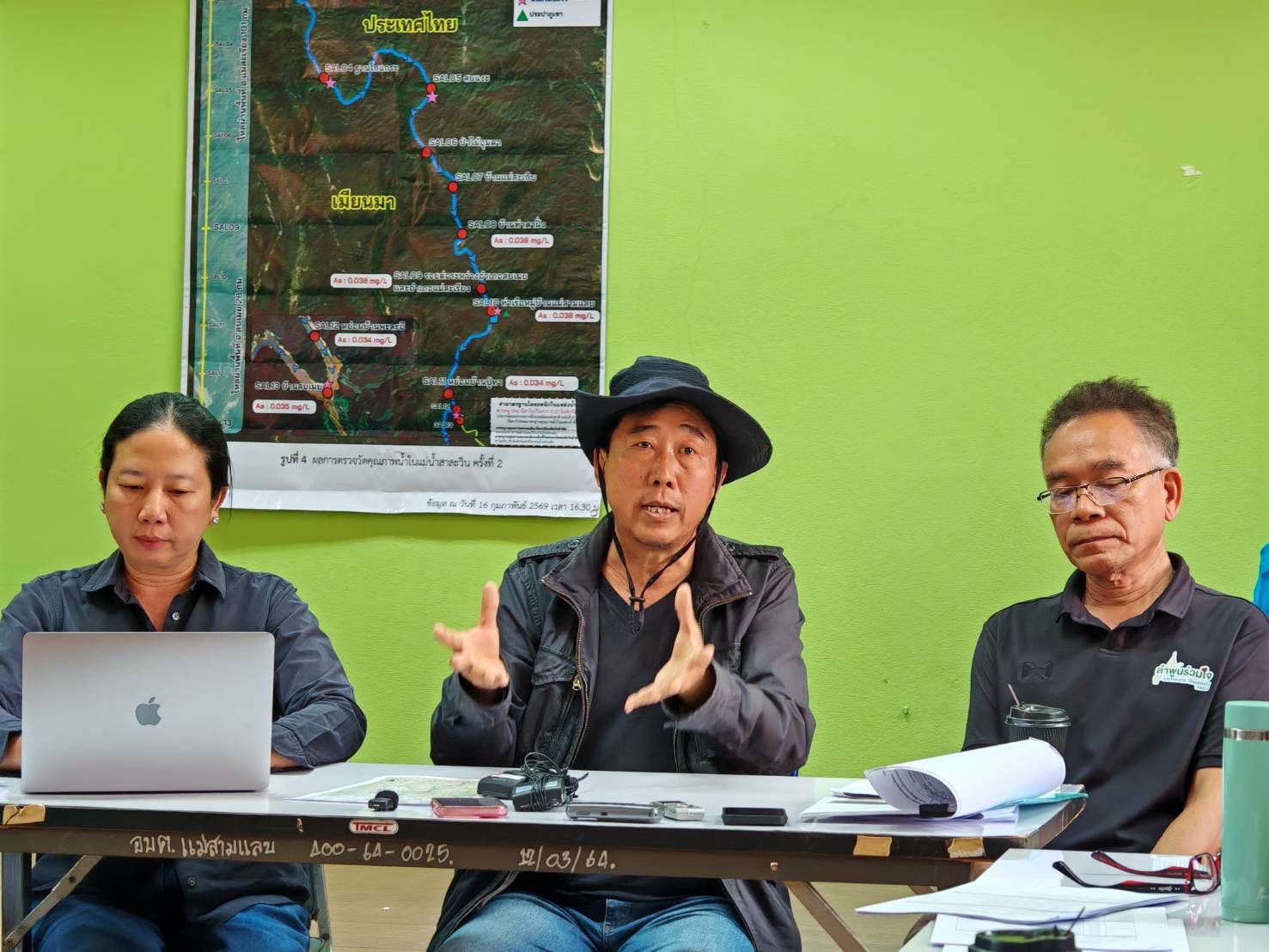
Aweera Pakkamart, Director of the Environmental and Pollution Control Office 1 in Chiang Mai, said on Friday that the office has tested the river’s water quality along communities from Tha Ta Fang to Sob Moei twice since last November and found that the water has been contaminated by toxic heavy metals above safe limits, especially arsenic. Levels were two to three times higher than the standard (0.01 mg/L, or 10 micrograms per litre [μg/L]), he said.


Graphics courtesy of PCD’s Chiang Mai Office
What surprised him was that arsenic contamination in the second test was higher than in the first, despite the water not being turbid. The test results suggest it may be present in a hazardous form due to dilution by chemicals used in mining processes, he noted.
“Various water tests are being conducted at the moment, but the results suggest a consistent trend of arsenic contamination in the Salween River,” said Mr. Aweera.
Mr. Aweera said toxic contamination in the Salween River poses a grave concern and could have even more severe impacts in the future, especially on future generations. This is because demand for minerals in upper Myanmar is no longer limited to specific minerals, as it was in the past. Current demand has led to the mining of “all types” of minerals, and the use of chemicals in production is “unlimited,” he said.
The production of some minerals, such as rare-earth elements, involves injecting large quantities of chemicals into mountains, and these chemicals are likely to be left behind without any environmental restoration under current laws, he said.
Lessons learned from Kachin State
Zung Ting, a former officer with international development agencies in Kachin State and now an independent environmental activist, shared his experience from Kachin, where rare earth elements have been extensively exploited.
Mr. Ting apologized for what happened upstream in Myanmar and said it is not the fault of ordinary people there. He added that the exploitation of mineral resources is tied to years-long armed conflict and subsequent ceasefires, which create opportunities for the parties involved—be they the junta, armed groups, or major investors such as China—to take advantage of the situation to exploit resources.
This holds particularly true after the 2021 coup and the latest round of fierce fighting that followed. The escalation prompted a boom in rare-earth mining in the area, as armed groups sought revenue to support their operations, he said. He added that Chinese investors own mining businesses there.
The issue has since become a transboundary issue, extending beyond Kachin and Myanmar and carrying regional and global impacts, he added.
“Thai people have demanded that mining should stop, but they (the armed groups) cannot. At present, the armed groups have introduced regulations that have put pressure on China. Chinese investors are now facing some difficulty operating mining businesses there, so they have sought to diversify their operations. That is why it has spread to Shan State, Wa areas, and other regions,” said Mr. Ting.
Pianporn Deetes, Executive Director of the Rivers and Rights Foundation and a former Southeast Asia campaign director for International Rivers, who has worked with local villagers since the beginning, said the Salween is an important river in the region and remains largely pristine because no large dams have been built to obstruct its course.
For the past 20 years, villagers on both sides of the Salween River have worked together to protect it and have campaigned against dam construction, resulting in no dams being built along the river. They also regularly hold events to commemorate the Salween on the International Day of Action for Rivers. However, this year they face a new challenge: a mining crisis upstream in Myanmar.
“The discovery of toxic chemicals in the Salween River means that those of us who have lived along and protected the river for so long are now at risk from toxic contamination,” said Pianporn
Ms. Pianporn noted that what has happened to the Salween is the same story as in the Kok River and other rivers, describing transboundary toxic river contamination caused by unregulated, or even illegal, mining upstream in Myanmar.
She said the governments on both sides are apparently inactive in addressing the problem, adding that this reflects how current politics in both countries are shaping the issue. She added that the issue has been downplayed and localised by the governments.
“They are apparently not acknowledging that there is a problem. Without acknowledging the problem, how can we expect them to solve it?” Ms. Pianporn said.

Photo: Sayan Chuenudomsavad
The renewed fight
However, the villagers in the affected communities have not stopped pushing for solutions. On March 14, the International Day of Action for Rivers, they once again organised an event to raise public awareness near the confluence of the Moei and Salween rivers.
Along with rituals and a children’s march, the villagers issued a statement calling on relevant agencies to monitor water quality in the river and disclose the information transparently to the community.
They also called on the government to develop a plan to restore the river ecosystem and provide relief to communities affected by toxic substances; guarantee the basic rights of the people by providing communities with access to clean tap water and safe electricity; and utilise international cooperation mechanisms to address transboundary pollution problems and implement measures to control or halt mining activities that contaminate the rivers.
“We, children and youth, are well aware that the river is our home, our food source, and our way of life. Today, we have gathered to declare our will to join together in protecting our homeland, our way of life, and our natural resources,” declared the children of Sob Moei village on behalf of their Karen communities.

Photo: Sayan Chuenudomsavad
Also see more photos at:

Indie • in-depth online news agency
to “bridge the gap” and “connect the dots” with critical and constructive minds on development and environmental policies in Thailand and the Mekong region; to deliver meaningful messages and create the big picture critical to public understanding and decision-making, thus truly being the public’s critical voice