
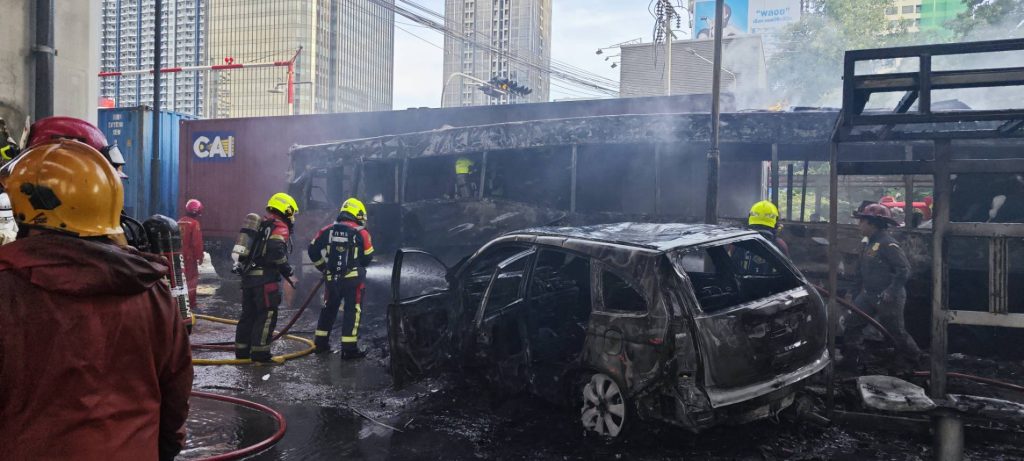
The Transport Ministry has revealed immediate and long-term measures to overhaul railway transportation management in Bangkok following the severe collision accident on Saturday, while wrongdoers will not be spared, according to the Ministry
The ministry, led by Deputy Prime Minister and Minister of Transport Pipat Ratchakitprakarn and Deputy Minister Siripong Angkasakulkiat, held a press conference yesterday outlining measures to overhaul railway transportation management in Bangkok to ensure public safety in both the short and long term.
On Saturday afternoon, a freight train travelling from Laem Chabang in Chon Buri Province to Bang Sue Station collided with a public bus at the Makkasan level crossing on Asoke Road. The accident resulted in eight deaths and 30 injuries. Although such incidents are rare in the heart of the city, the risk of accidents remains high because the railway and roadway intersect at the same ground level.
According to the ministry, eight level crossings on the Northern and Northeastern lines within the city have already been addressed through the development of the Red Line elevated railway. However, 16 locations on the Eastern Line and three additional locations on the Western and Southern lines remain pending the construction of the Missing Link section connected to Bang Sue Central Station, also known as Krung Thep Aphiwat Central Terminal.
The ministry’s permanent secretary stated that delays in the construction of the Missing Link resulted from delays in work at the central station, which now serves trains travelling to and from the North and Northeast.
For passenger trains operating on the affected lines, the ministry will immediately implement a strict “No Safety Barriers, No Train Passage” policy. Under this rule, trains will not be permitted to pass through a level crossing unless safety barriers are fully operational. This measure will be implemented alongside upgrades to the synchronised traffic management system, as well as stricter traffic enforcement to ensure that road users remain behind the designated yellow lines at crossings.
In the medium term, the ministry is considering revising transportation plans to prevent long-distance and suburban trains from entering inner Bangkok. Trains on the Western and Southern lines would terminate at Taling Chan Station in outer southern Bangkok, which connects to the Red Line, while trains on the Eastern Line would terminate at Lat Krabang Station, which connects to the Airport Rail Link in eastern Bangkok.
Alternatively, the Bangkok Mass Transit Authority (BMTA) may provide shuttle bus services to transport passengers further into inner-city areas. The government also plans to introduce an integrated ticketing system to prevent fare increases and assist vulnerable groups, the ministry stated.
In the long term, the ministry will accelerate the completion of the elevated Missing Link section connecting Phaya Thai, Yommarat, and Bang Sue Central Station, which will serve as the country’s primary railway terminal. At the same time, the ageing Hua Lamphong Station will be decommissioned.
Regarding freight trains, the ministry has immediately prohibited oil tankers from entering the city. Other freight trains carrying goods will be required to stop and transfer cargo at warehouses or stations in outer areas such as ICD Lat Krabang in the east, Ban Phachi in the north, and Nakhon Pathom Province in the west. Freight trains that must enter the inner city will only be permitted to operate at night under strict safety measures, including mandatory safety barriers.
In the long term, the Third Ring Road (MR10) will be constructed under the MR-Map plan, allowing freight vehicles to bypass the city and creating a multimodal transportation hub connecting road and water transport systems in suburban areas.
Mr. Pipat stated that he has instructed relevant officials to study medium- and long-term measures and complete the study within the next three months, and report to him.
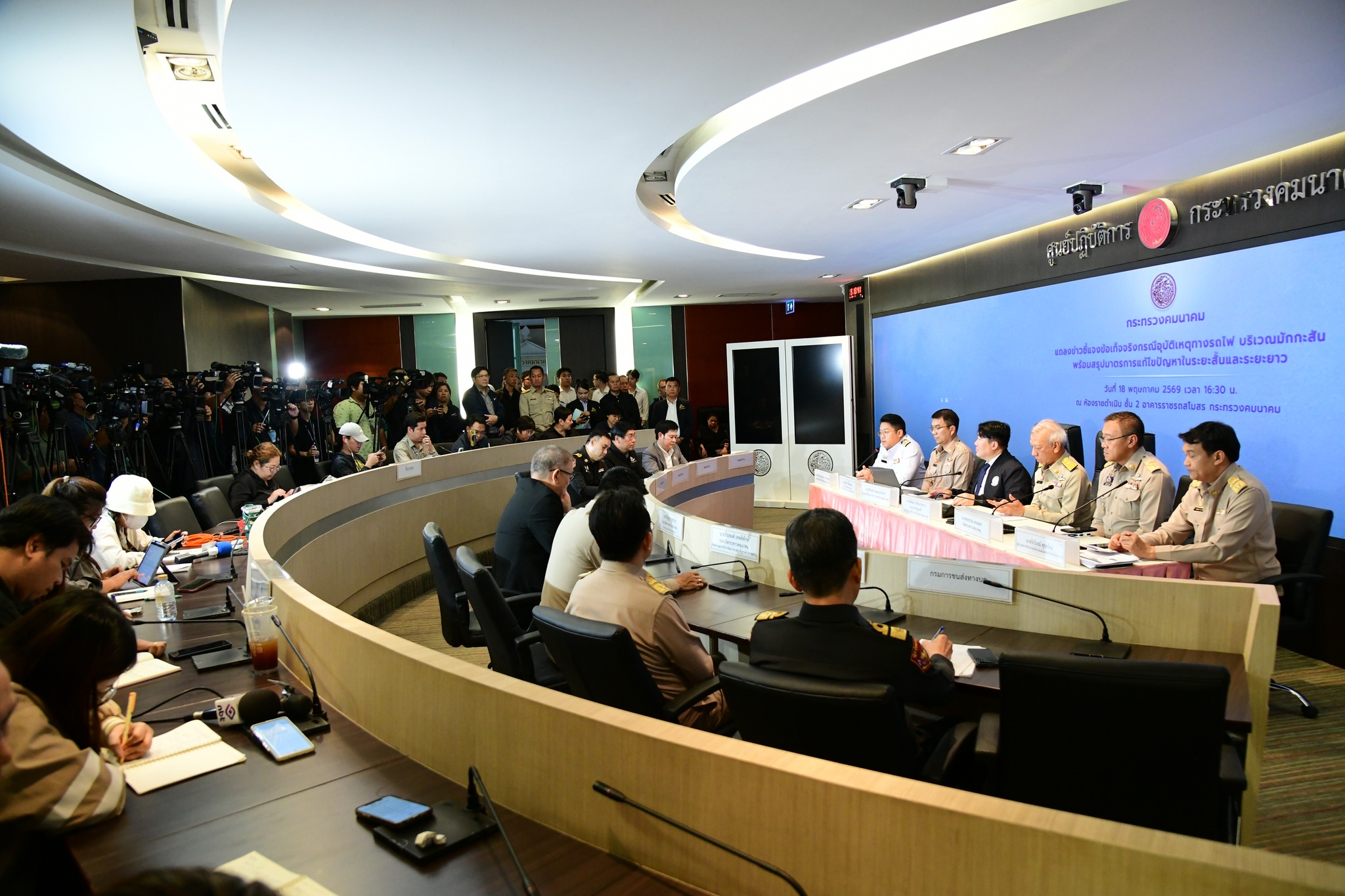
The damaged parties & wrongdoers
The ministry is currently handling the related cases and providing compensation to the families of those who died, as well as to those who were injured. In cases of death, initial compensation of 2,090,000 baht per person has been established, in addition to further contributions.
For injured victims, the BMTA will cover actual medical expenses ranging from 80,000 to 1,000,000 baht and will provide additional compensation if costs exceed this limit. In addition, 30,000 baht will be provided through partner networks, while another 20,000 baht will be donated from the accident fund.
The State Railway of Thailand (SRT) will provide initial assistance of 5,000 baht and additional compensation based on the severity of injuries, up to a maximum of 50,000 baht for cases requiring ICU admission, Mr. Siripong stated.
To provide ongoing care and support for those affected, the BMTA will take responsibility for all third-party property damage and deploy teams to provide daily psychological support to injured individuals until they are discharged from the hospital.
Mr. Siripong stated that the ministry would not protect wrongdoers and that the operation would be divided into three parts.
For criminal offences, the police will prosecute offenders strictly according to the law. The State Railway of Thailand will act as the plaintiff in legal proceedings against the train driver for negligence resulting in death.
For disciplinary offences, the SRT and the BMTA will establish investigation committees at all levels. If investigators determine that officers neglected their duties, those officers will be suspended from duty immediately and subjected to disciplinary action.
Lastly, the ministry also plans to upgrade railway safety standards under the Rail Act by enforcing standards equivalent to those used in the aviation sector. Random checks will be abolished, and all public transport drivers from the State Railway of Thailand, Bangkok Mass Transit Authority, and Transport Co., Ltd. will be required to undergo alcohol testing before beginning their duties each day, without exception, Mr. Siripong said.
“I have instructed the SRT to implement this directive urgently and produce tangible results immediately. Within three months, they must complete studies on comprehensive measures, including methods to mitigate potential impacts, and report their progress to me monthly to ensure that the process is expedited and that the public is reassured that such a tragedy will not occur again,” Mr. Pipat said.
Asked whether and how he would take responsibility for the accident, Mr. Pipat said that the facts must first be carefully scrutinised and established, and that he would take responsibility for the incident if it were proven that his policies or directives had played a role.

Indie • in-depth online news agency
to “bridge the gap” and “connect the dots” with critical and constructive minds on development and environmental policies in Thailand and the Mekong region; to deliver meaningful messages and create the big picture critical to public understanding and decision-making, thus truly being the public’s critical voice