
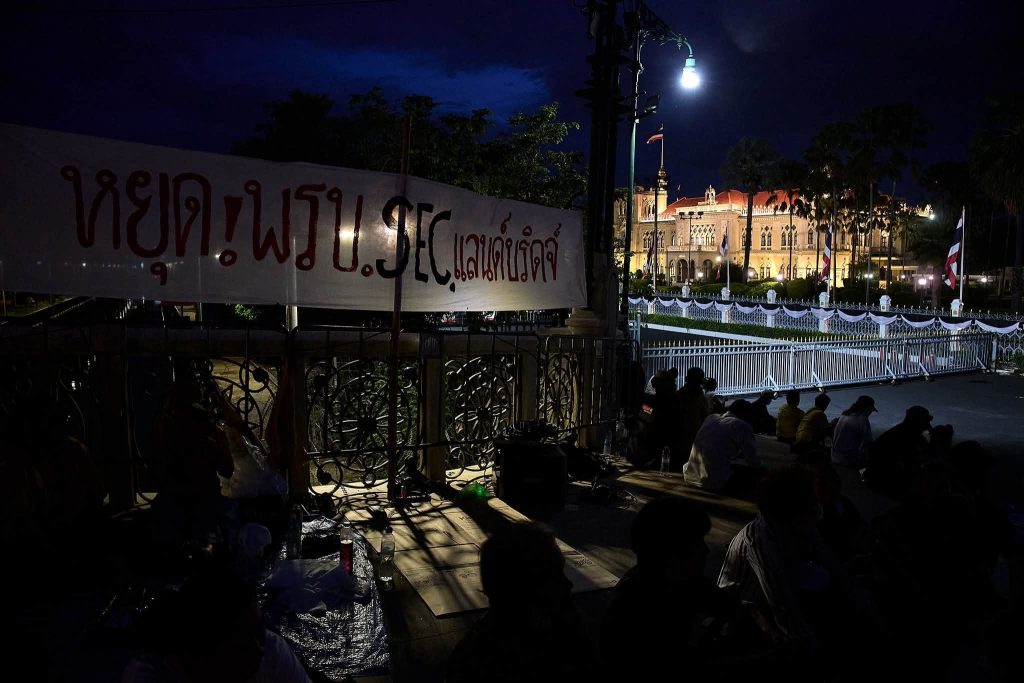
A week-long civil disobedience-style protest by southern residents and civil society groups against the draft Southern Economic Corridor (SEC) Act and the Land Bridge megaproject ended in victory after the government bowed to pressure and agreed to scrap the draft legislation
After camping outside Government House for nine days since June 22 and defying government restrictions on approaching the compound, protesters from several southern provinces, led by SEC Watch and EEC Watch, secured their first major victory on the issue despite their relatively small numbers.
Following two days of tense negotiations that concluded on Tuesday, government representatives, led by Deputy Prime Minister and Transport Minister Phiphat Ratchakitprakarn, agreed to all five of the protesters’ demands. A Memorandum of Agreement (MOA) was signed between Mr. Phiphat and SEC Watch representative Prasitchai Noonual, a long-time campaigner against megaprojects in southern Thailand.
Under the MOA, both sides agreed to abandon the push for the Southern Economic Corridor Act, which is being drafted by the Office of Transport and Traffic Policy and Planning (OTP) under Mr. Phiphat’s ministry. The draft legislation will not be submitted to the Cabinet for consideration, according to the agreement.
Secondly, the two sides agreed to establish a new committee to prepare a master plan for southern development. The committee will be chaired by Deputy Transport Minister Siripong Angkasakulkiat and include representatives from relevant government agencies, including the Office of Transport and Traffic Policy and Planning, as well as representatives from SEC Watch. It will conduct a comprehensive study on sustainable development for the southern region.
Thirdly, both sides agreed to delay the Land Bridge megaproject linking Ranong and Chumphon until the completion of both the ongoing study by the government-appointed committee, chaired by the Deputy Prime Minister and Finance Minister, and the study to be conducted by the new committee. (Read: SPECIAL REPORT: Land Bridge, bridging or widening Thailand’s economic gap?)


Photos: Bangkok Tribune
Mr. Phiphat also committed to forwarding the protesters’ fourth demand to Prime Minister Anutin Charnvirakul, urging him to review the government’s plan to include Prachin Buri province in the Eastern Economic Corridor (EEC). He also pledged to inform the Prime Minister about the slow progress in providing compensation to local residents affected by EEC projects, including small-scale fishers impacted by coastal reclamation for state transport infrastructure.
During the negotiations, Mr. Phiphat said that, as the minister responsible for the draft legislation, he would neither sign nor submit the draft Act to the Cabinet. As a result, the draft would effectively be withdrawn.
The government was prepared to scrap the legislation and establish a new committee to study development options for the South together with the protesters, he said, adding that the Prime Minister had instructed him to negotiate with the group.
“We will withdraw every draft currently under consideration. Previously, there were also draft bills proposed by political parties, but they were dropped following a House resolution, leaving only the ministry’s draft. As I will not submit it to the Cabinet, it cannot proceed because I must first endorse it. Therefore, I can confirm that we will stop pushing this proposal, and there will no longer be an SEC Act,” Mr. Phiphat said.
However, Mr. Phiphat did not rule out the possibility that the idea could be revisited in the future, saying that any further action would depend on the findings of the new committee.
Mr. Prasitchai took a different view. Speaking to protesters after receiving the MOA on July 1, he insisted that the SEC draft Act had effectively been scrapped because Mr. Phiphat had clearly stated that he would no longer pursue it.
The Land Bridge project and related implementation processes would also be put on hold, he said, as the project would now have to await not only the findings of the government’s committee but also those of the new committee, in which the protesters will participate.
“In other words, the project has become invalid,” Mr. Prasitchai said.
Mr. Prasitchai added that the two sides would discuss the timeframe and composition of the new committee in greater detail, as he believed that ministries other than the Ministry of Transport should also be represented.
The ultimate goal, he stressed, is to steer southern Thailand toward sustainable development.
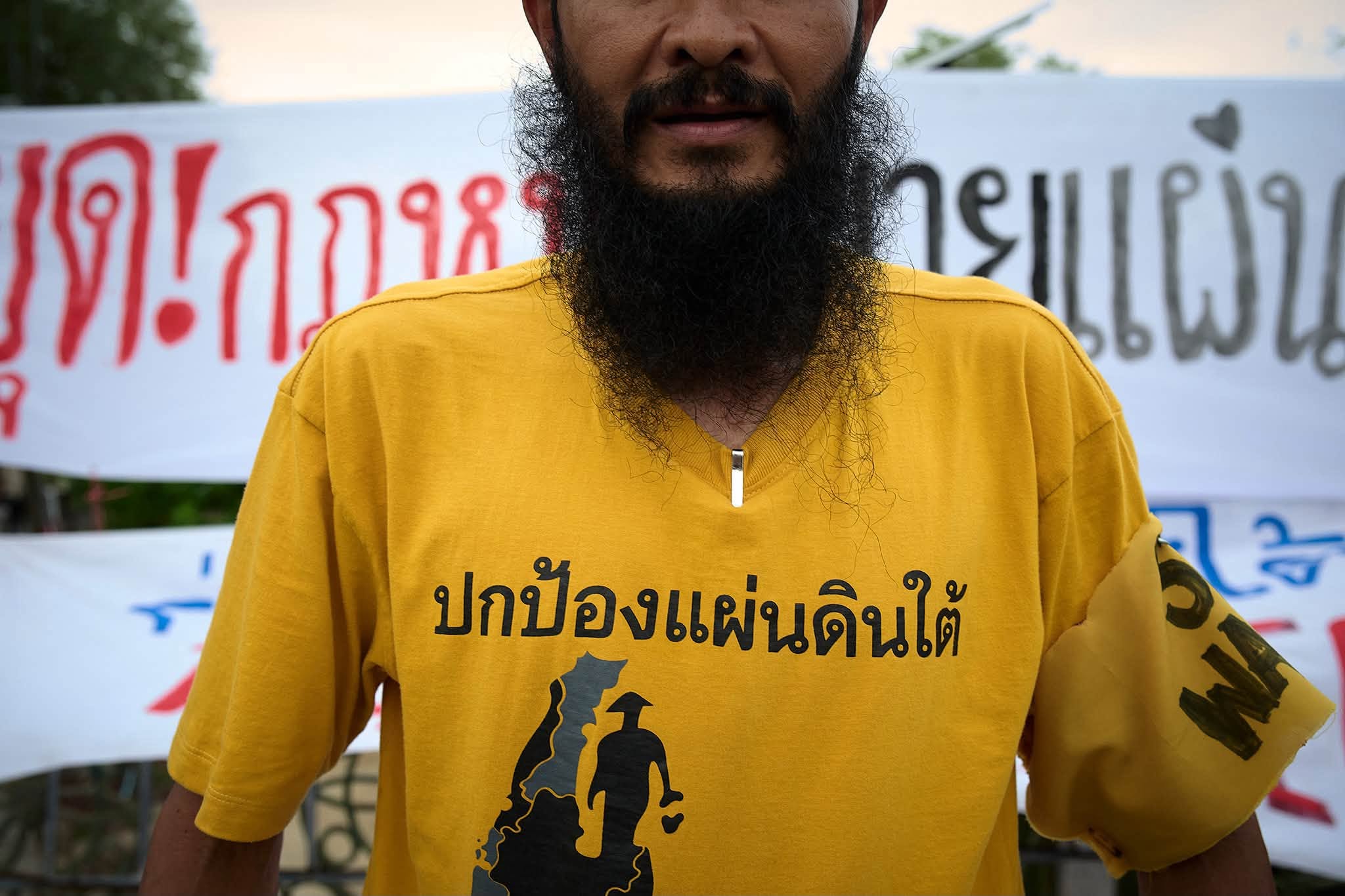
Civil disobedience
Since June 22, protesters from several southern provinces — from Ranong and Chumphon to Krabi and Nakhon Si Thammarat — have travelled to Bangkok to camp outside Government House without setting a deadline for ending their protest. They made it clear that they would return home only after securing a victory.
Day after day, despite their relatively small numbers, the group of protesters took turns maintaining the encampment outside Government House, ensuring that their presence remained constant and even grew on some days.
After more than five days of protesting outside Government House without receiving a response to their demands, the group escalated their campaign by moving the protest site closer to the compound, where they staged peaceful sit-ins and continued the overnight protest to increase pressure on the government. They also called for nationwide demonstrations targeting the ruling Bhumjaithai Party.
The group argued that the government’s policy of pushing forward the draft SEC Act and the Land Bridge project would ultimately damage the Thai economy because of the nature of special economic zones.
The protesters said government ministers continued to promote the legislation despite what they described as its harmful consequences, claiming it would place Thailand’s land and natural resources increasingly under foreign control.
They also rejected the government’s claims that special economic zones would generate economic growth and create jobs, describing those claims as “deceptive” in light of the experience of the Eastern Economic Corridor (EEC).


Photos: Sayan Chuenudomsavad
On employment, the group claimed that a large proportion of workers in the EEC are foreign nationals because the law facilitates the recruitment of foreign labour. At the same time, they argued, protections for occupations traditionally reserved for Thai citizens have been weakened, allowing wholly foreign-owned companies to operate more freely. As a result, they claimed, employment opportunities for Thai workers have declined since the establishment of the EEC.
The protesters also argued that the Thai economy has steadily deteriorated since the Eastern Economic Corridor Act came into force in 2018. They claimed that the policy of developing the zone as a manufacturing hub for foreign investors has weakened the competitiveness of Thai businesses. Citing Thailand’s economic growth of less than 2 per cent this year, they argued that expanding similar special economic zones elsewhere in the country could eventually turn Thailand into what they described as a “colony” of foreign powers.
The group further claimed that extensive privileges granted to foreign investors had resulted in environmental pollution in the eastern region while providing little benefit to the country. If the same model continued, they warned, Thailand could face a food production crisis, followed by broader economic and environmental damage.
Accordingly, the protesters demanded that the government immediately stop pursuing the Southern Economic Corridor (SEC) Act and suspend all legal procedures and implementation of the Land Bridge project, including work related to ports, expressways and railways. They also called for the establishment of a new committee to draft a southern development master plan that, they said, would promote sustainable development in the region.
“The Thai people are well aware that this government has absolute power, but history around the world shows that power used to oppress the people never ends well. Therefore, the expansion of development in the form of special economic zones amounts to oppression of the nation and a significant loss of “national sovereignty”. We urge the government to return to the proper and legitimate path of governance by addressing the five demands of the people.
“Therefore, the people have no other choice. We must fight to preserve the country’s sovereignty. We will remain camped outside Government House until the government returns to a legitimate course of governance,” the group said when announcing the escalation of its protest.
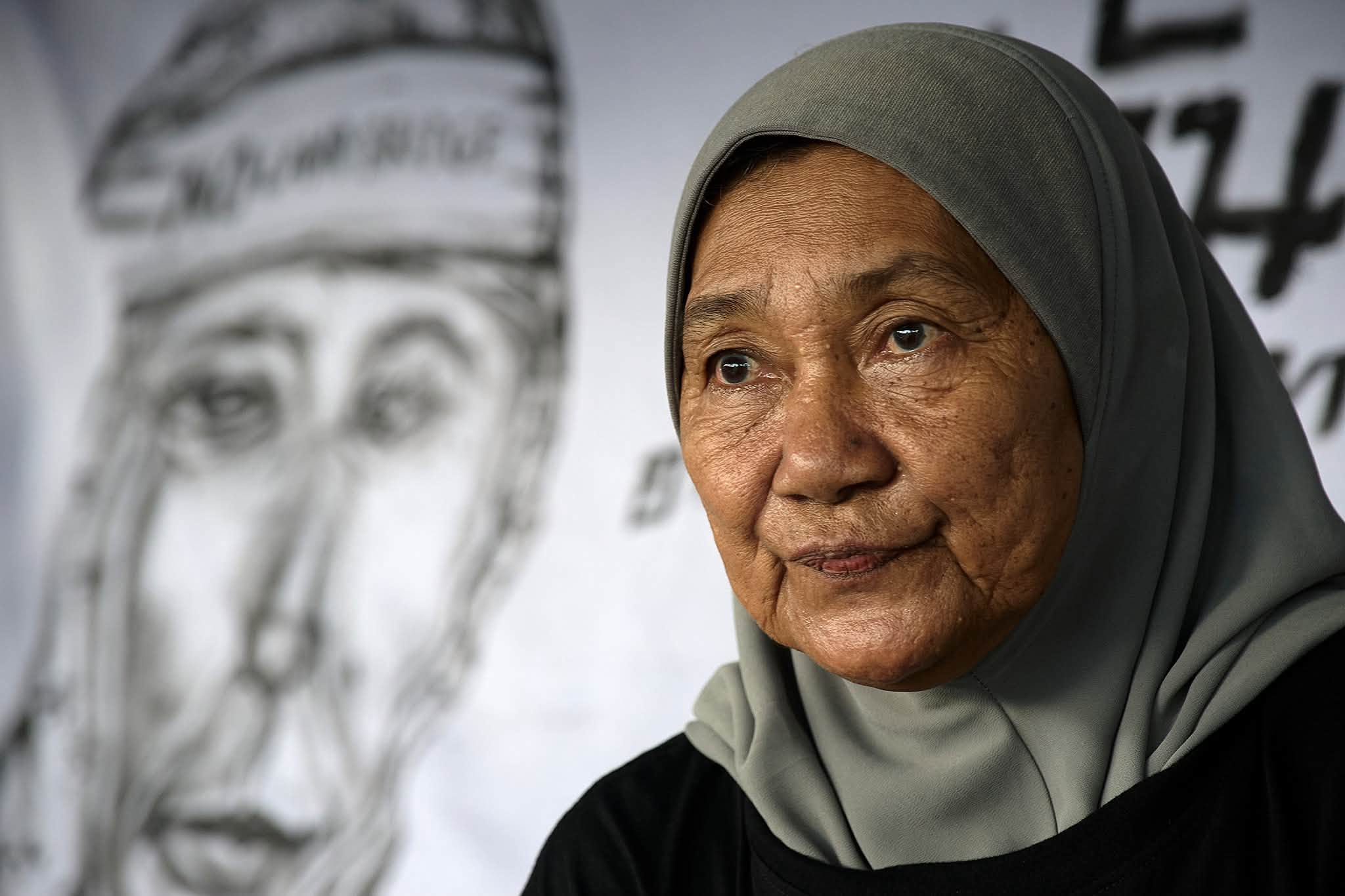
Group leaders told Bangkok Tribune that the protesters’ success was the result of years of consultation among local communities after residents first learned of the proposed legislation several years ago. Civil society groups promoting sustainable development, together with community leaders, travelled from one community to another to explain the implications of the draft law and its potential impact on local livelihoods.
Although only a relatively small number of protesters were able to remain in Bangkok, many more residents across the South expressed their support by holding banners opposing the draft law and the Land Bridge project and sharing their messages on social media.
One group leader said the issue had become particularly sensitive for the government because of public concerns over national sovereignty.
“The government fears being labelled as betraying the nation at a time when there is growing public concern over foreigners acquiring land and other assets in Thailand,” the leader said.
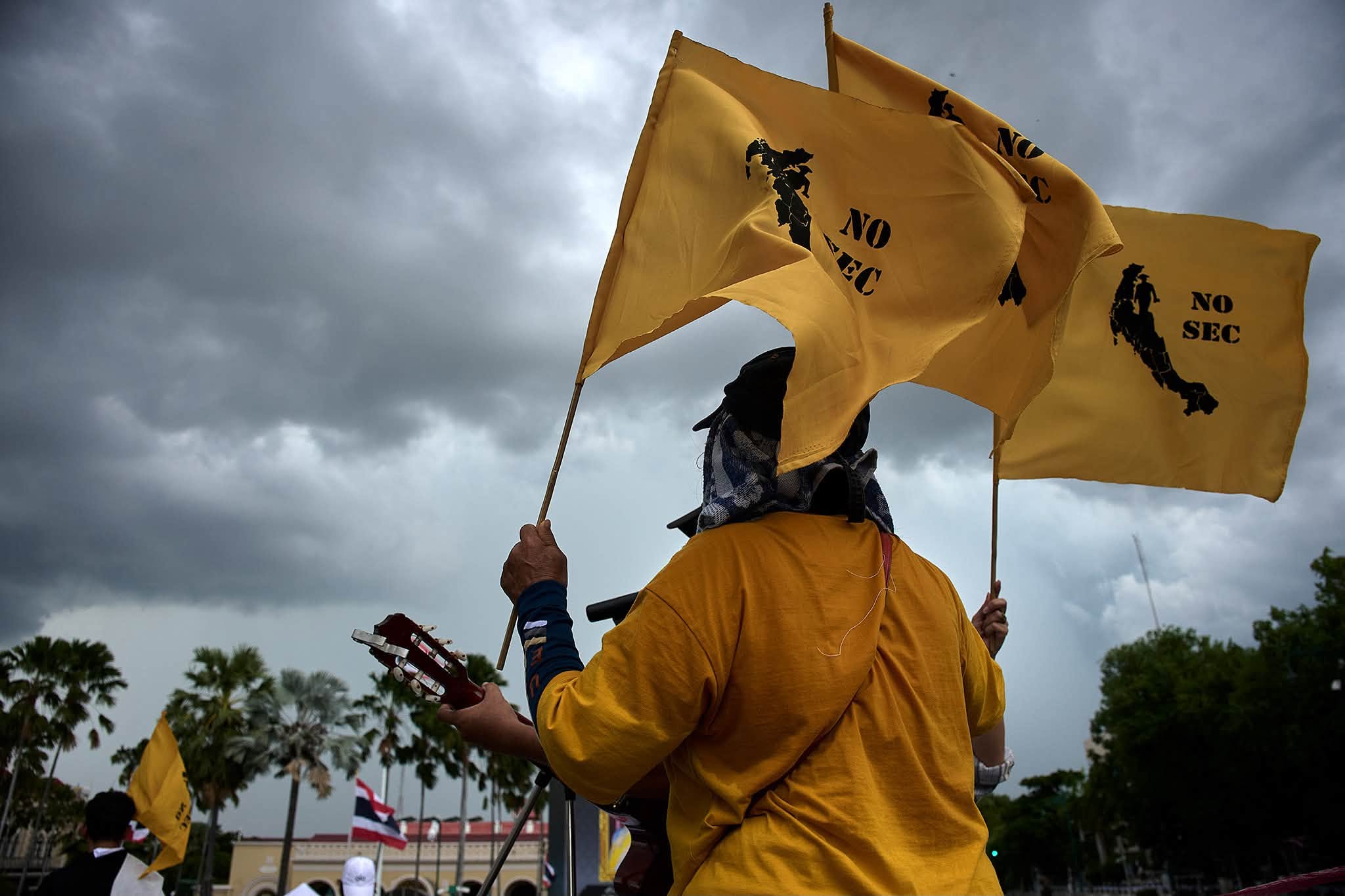
SEC
The Southern Economic Corridor (SEC) is part of the Special Economic Zone (SEZ) policy introduced under the government of General Prayut Chan-o-cha during 2014-2-23, which aimed primarily to promote economic growth. The policy is reflected in the 20-Year National Strategy (2018–2037), the Master Plan under the National Strategy (2023–2037), and the 13th National Economic and Social Development Plan (2023–2027).
In line with this policy, the government started to draft the Southern Economic Corridor Act. On Sept. 20, 2022, the Cabinet approved the designation of Chumphon, Ranong, Surat Thani and Nakhon Si Thammarat as provinces within the Southern Economic Corridor.
The proposed SEC Act was intended to provide the legal framework for developing the Southern Economic Corridor, including the Land Bridge project, one of the government’s flagship infrastructure initiatives for the South.
Modelled on the Eastern Economic Corridor (EEC), the SEC was designed to establish a new special economic zone aimed at attracting investment and accelerating economic development in the region.
The proposal, however, has faced strong opposition from local residents.
Read more special reports @bkktribune.com

Indie • in-depth online news agency
to “bridge the gap” and “connect the dots” with critical and constructive minds on development and environmental policies in Thailand and the Mekong region; to deliver meaningful messages and create the big picture critical to public understanding and decision-making, thus truly being the public’s critical voice