

The endorsement drew flak among riverine communities, who immediately called for a probe into the government’s decision for fears of further transboundary impacts
The National Energy Policy Council (NEPC), chaired by Prime Minister Gen Prayut Chan-o-cha, on Wednesday reportedly acknowledged the core content of the draft Power Purchase agreements for the Luang Prabang and Pak Lay dam projects on the Lower Mekong during its fourth meeting this year.
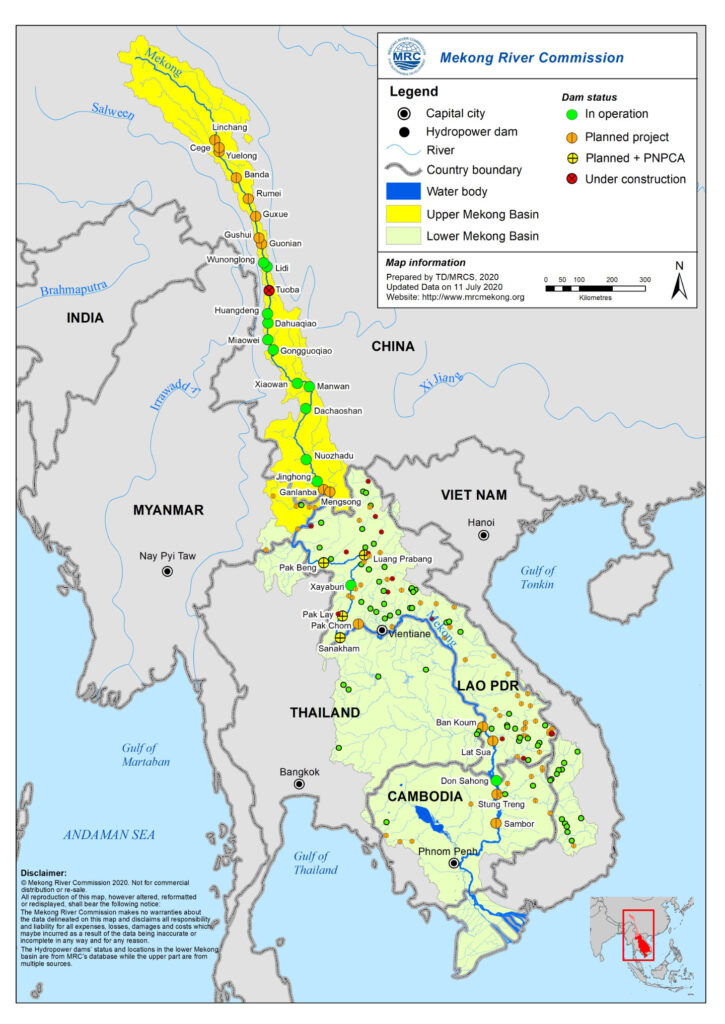
The fourth and fifth projects proposed on the river section are now explicitly approved to proceed following the PPA endorsement, after the first Xayaburi dam and the second Don Sahong dam, both of which have drawn significant controversy for their alleged destruction of the river’s ecosystems.
Energy Minister and Deputy PM Supattanapong Punmeechaow said the council also assigned the Electricity Generating Authority of Thailand (EGAT) to seal deals with the dam developers.
The draft PPAs have been examined by the Council of the State already, he further said, adding if there are any amendments including work timetables as well as “milestones” in relation to power distribution without compromising the purchase rates agreed upon, the organization’s panel can make a decision on its own over the matters.
The council decided on the power purchase deals, along with other critical decisions, including delaying the discharge of some old power generation plants at Mae Mo in Lampang province to help stabilise the fluid energy shortage amid multiple crises.
PM Prayut was quoted as saying during the meeting that he wanted the relevant agencies to explore alternative and renewable energy sources to maintain the country’s energy supply and that “there must not be a shortage of power.” He instructed the agencies not to create repercussions against government policy on carbon neutrality while pursuing such energy sources. These sources must undergo rigorous research and analysis to assess their potential, he said. The committee considers hydropower one of these energy sources, according to its meeting records.
During its last meeting in May, the council also acknowledged the draft PPA for the Pak Beng dam project, the third in the line, which is strongly opposed by riverine communities in the north due to its relatively close proximity, only around 100 kilometers from the Thai-Lao border in Chiang Rai province. No assignment of the deal signing was reported.


Where is the river’s “legal right”?
The NEPC’s decision came as representatives of Mekong riverine communities, as well as those from its tributaries, gathered on Wednesday afternoon to discuss the best way to protect the Mekong River and its tributaries, drawing on their direct experiences and lessons learned about dam impacts on these rivers.
New ideas concerning “legal right” and “legal personhood” were shared and explored among the participants both on-site and online during the forum, Can the Mekong and its tributaries have “legal rights”?, raising hopes that such new legal concepts and tools could provide better protection to the rivers, which over the years have been deteriorated by the mega-construction projects without proper protection by any current legal frameworks and mechanisms. (Watch a recording @bkktribune.com)
“Power purchase continues as it does, and so do corporate investments and benefits, something that the law can never catch up,” said Ms Ormbun Thipsuna, Secretary-General of the Network Association of the Mekong Community Organisations Council of the Seven Northeastern Provinces, who had joined the forum and posted on her Facebook account upon learning about the government’s decision.
Her group, which joined other Mekong communities yesterday under the name the Thai Mekong People’s Network from Eight Provinces, inked a petition to be submitted to the Parliament’s public participation and political development sub-panel, asking for an immediate probe into the government’s decision. They cited the main reason as the lack of public involvement in such critical decision-making. At the same time, transboundary impacts from the Mekong dams are already clearly observed and experienced by downstream communities and have not been adequately addressed to date.
“This is for accountability, transparency, as well as public participation to be promoted as they are supposed to, “said the group in their letter.
Updated/ June 25: They also submitted the petition to the PM himself, asking him to review the decision.
The fourth and the fifth dams
The Pak Lay dam project was proposed as the fourth in line under the Mekong River Commission (MRC) regional consultation mechanism in mid-2018. It is planned on the Mekong mainstream in Pak Lay district in north-western Lao PDR’s Xayaburi province, around 100 kilometres downstream of the Xayaburi dam and around some 60 km from the Thai-Lao border in Loei province.
The dam will be run-of-river, operating continuously year-round to produce 770 megawatts of electricity, according to the MRC. Power China Resources Ltd. was first named as its developer with the investment cost estimated at US$ 2,134 million. The construction is set to start this year and the commercial operation would begin when the construction finishes in 2029.
On June 13, 2018, the Lao government notified the MRC Secretariat of its intention to undertake the so-called Prior Consultation for the project.
Under the MRC’s procedures, any infrastructural project “using the mainstream water during the dry season within the same basin”, as well as “during the wet season between two basins”, must undergo the prior consultation process. Applicable projects include large-scale irrigation and hydropower development, which may have significant environmental impacts on the flow and quality of the Mekong mainstream.
As the procedure is clearly intended to enable the parties involved to reach an agreement on how the consulted case should proceed, and as the MRC itself has stressed, it is generally understood that the project has implicitly commenced.
During the wrap-up of the 6-month consultation, which ended in April 2019, the four-country members of the MRC had called on Laos through the official statement “to make every necessary effort to address and mitigate potential adverse cross-border impacts of the project” by taking into account recommendations provided in the Technical Review Report resulted from the consultation process.
“We found that it (Pak Lay project) is needed for further identification of the transboundary environmental impacts, considering a great assessment and proper mitigation plans and measures,” Cambodia’s Reply Form read.
Thailand also shared similar comments, asking Laos to pay special attention to “potential socioeconomic and environmental transboundary impacts from the proposed project to affected communities in eight provinces of the country”, the MRC noted.
Viet Nam, in addition, suggested Laos to invest more time and resources on additional data collection and improvement of applied impact assessment to address possible impacts across borders in “a more comprehensive manner”. It also recommended the development of “a comprehensive program for monitoring the impacts of the project during construction and operation stages”, according to the MRC.
The project also developed a new mechanism to address potential impacts of the dam during construction and after operation. It’s called a Joint Action Plan, which outlines measures for the post-prior consultation period and mechanisms for ongoing feedback, data exchange, and knowledge sharing among the developer, the MRC, and stakeholders on the design, construction, and operation.
The JAP was first developed during the consultation for the third proposed Pak Beng dam project.
“The purpose is to enhance existing measures to avoid, minimize and mitigate the potential for transboundary impacts, and to enhance the benefits of the projects and the sharing of knowledge and experience amongst the member countries,” according to the MRC when addressing the benefits of the JAPs of Pak Beng and Pak Lay.
The 1,285-MW Xayaburi and 240-MW Don Sahong dams have no JAPs.

The Luang Prabang dam, meanwhile, is the fifth project submitted to the MRC’s prior consultation in October 2019. According to the MRC, the Luang Prabang dam was developed by Luang Prabang Power Company Limited, a company established under the Lao government and PetroVietnam Power Corporation’s 2007 MOU.
Located around 25 km north of Luang Prabang town, the project will have an installed capacity of 1,460 MW, with power to be sold to Thailand from 2027 onward, according to MRC, citing notification documents.
During the wrap-up session of the prior consultation for the Luang Prabang project, which ended in June 2020, it was reported that Thailand, Cambodia, and Viet Nam had requested Lao PDR to conduct “rigorous” transboundary impact assessments and enhance proposed measures to mitigate potential adverse impacts from the proposed dam.
While appreciating the Lao government’s submission of the project for prior consultation and cooperation, and recognising Laos’ sovereignty and rights to decide on the dam development, the MRC noted that it had requested that Laos take “due account” of its recommendations outlined in its Official Reply Form.
For instance, Cambodia called for further transboundary environmental impact assessments to be conducted, considering proper and effective mitigation plans and measures. And Vietnam said, “The cumulative impacts of the Luang Prabang Hydropower Project and all the Mekong mainstream hydropower projects should be comprehensively assessed.”
Thailand, meanwhile, said; “There is a proposal to Lao PDR and project developer to establish an Endowment Fund and determine transboundary impact mitigation measures in terms of socio-economic, livelihood and environment.”

In March last year, Xinhua reported on the progress of the Luang Prabang project and that its preparatory work was already 80 per cent complete. Among the preparatory work was the construction of an 11-km access road, a 500-metre bridge over the Mekong River, three temporary ports, transmission lines, and a small electricity station.
About 69 per cent of compensation payments to people who had to give up their land or other property for the project had already been made at that time, according to Xinhua.
And in April this year, the Chinese company was reported to have begun to prepare for construction on the Pak Lay dam, an official at the Energy and Mines Department of Xayaburi province told Radio Free Asia.
The developer has been preparing to build an access road, a workers’ camp, and a power source at the site since late 2021, RFA was told by the same official who declined to be named. The pre-construction phase was underway, but Laos and the company’s officials had not yet met with residents who may be affected by the dam, RFA reported, citing the same official.
This is similar to the Pak Beng dam, the third in the line. China Datang Overseas Investment, the developer of the Pak Beng Dam, was reported by the same news agency to have begun moving machinery to prepare the dam site and to set up workers’ camps in the same month. An official at the Lao Ministry of Energy and Mines told the agency that this was in anticipation of a PPA to be signed in May with EGAT.
In January and April, at least two Thai companies, CK Power Plc (CKP), the power generation arm of CH Karnchang Plc and Gulf Energy Development Plc were reported by the Bangkok Post as having been involved with the project either as a constructer or a co-developer of the projects.
They both cited the promotion of “clean energy” and “carbon neutrality” as the reason for joining the projects.

Indie • in-depth online news agency
to “bridge the gap” and “connect the dots” with critical and constructive minds on development and environmental policies in Thailand and the Mekong region; to deliver meaningful messages and create the big picture critical to public understanding and decision-making, thus truly being the public’s critical voice