
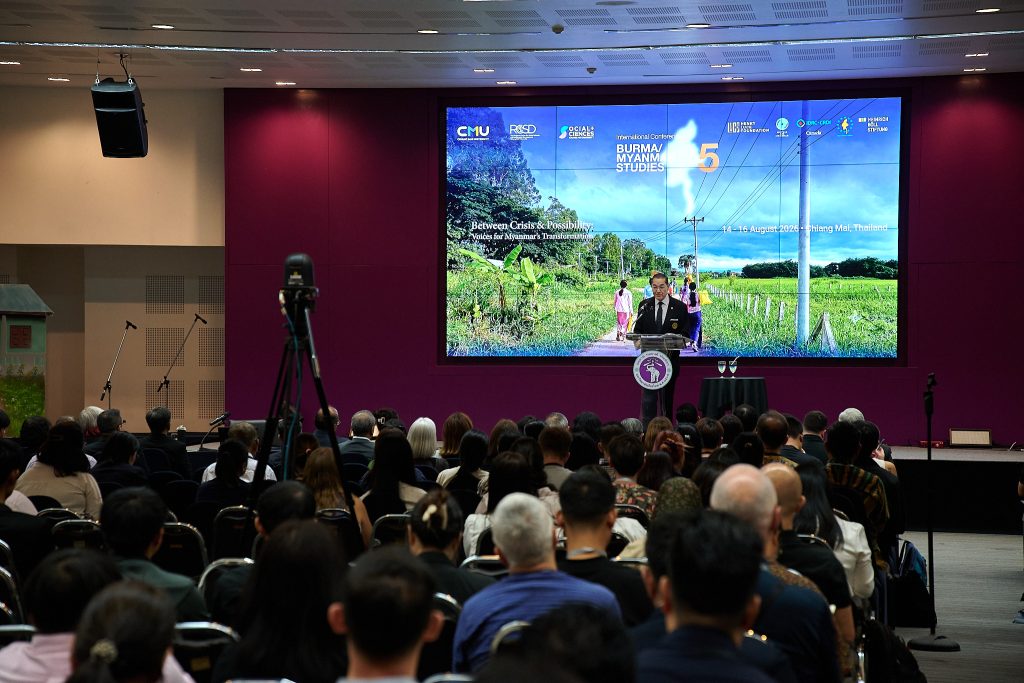
Over 900 scholars, researchers, and representatives of civil society organisations are attending the 5th International Conference on Burma/Myanmar Studies (ICBMS), taking place from today through August 16, to examine the social, political, and environmental transformations shaping Myanmar and its communities today
Organised for the fifth time by CMU’s Regional Center for Social Science and Sustainable Development (RCSD) and its supporting partners, this year’s conference is themed “Between Crisis & Possibility: Voices for Myanmar’s Transformation.” Over the three days of the conference, participants will explore the transformations Myanmar has undergone following the 2021 coup and the election through various sub-themes, including Powers, Proxies & Contested Resources; From Protest to Civil Disobedience; Legitimacy in Crisis; Elections & Federalism; Accountability, Rights & Reckoning; Care at the Frontlines; Health & Humanitarianism; Environment & Climate Justice; Agrarian Transition and Food Sovereignty; Borderland Capitalism & Illicit Economies; and others.
The conference was first held in mid-2015, with CMU hosting it under the theme “Burma/Myanmar in Transition: Connectivity, Changes and Challenges”. It was then followed by the second conference, which was the first and only time held inside Myanmar by Mandalay University and co-hosted by CMU in 2018, with more than 540 participants from 29 countries attending.
The third conference was delayed due to COVID-19 and was held shortly after the coup in Myanmar in March 2021. It was a hybrid event under the theme “Myanmar/Burma in the Changing Southeast Asia Context,” with a growing number of more than 1,000 participants joining from across the globe, both in person and online. The fourth conference was held again at CMU in 2024 under the theme “Assemblages of the Future: Rethinking Communities after the State,” with more than 800 participants attending.
At the fifth conference, 59 presentation sessions and 19 roundtables have been organised with more than 900 participants attending. The first day opened with keynote speeches and remarks by Professor Dr. Surakiart Sathirathai, Chairman of the Asian Peace and Reconciliation Council and Chairman of the Chiang Mai University Council, and Dr. Chayan Vaddhanaphuti, Chair of the ICBMS5 Organizing Committee and founding director of CMU’s Regional Center for Social Science and Sustainable Development.
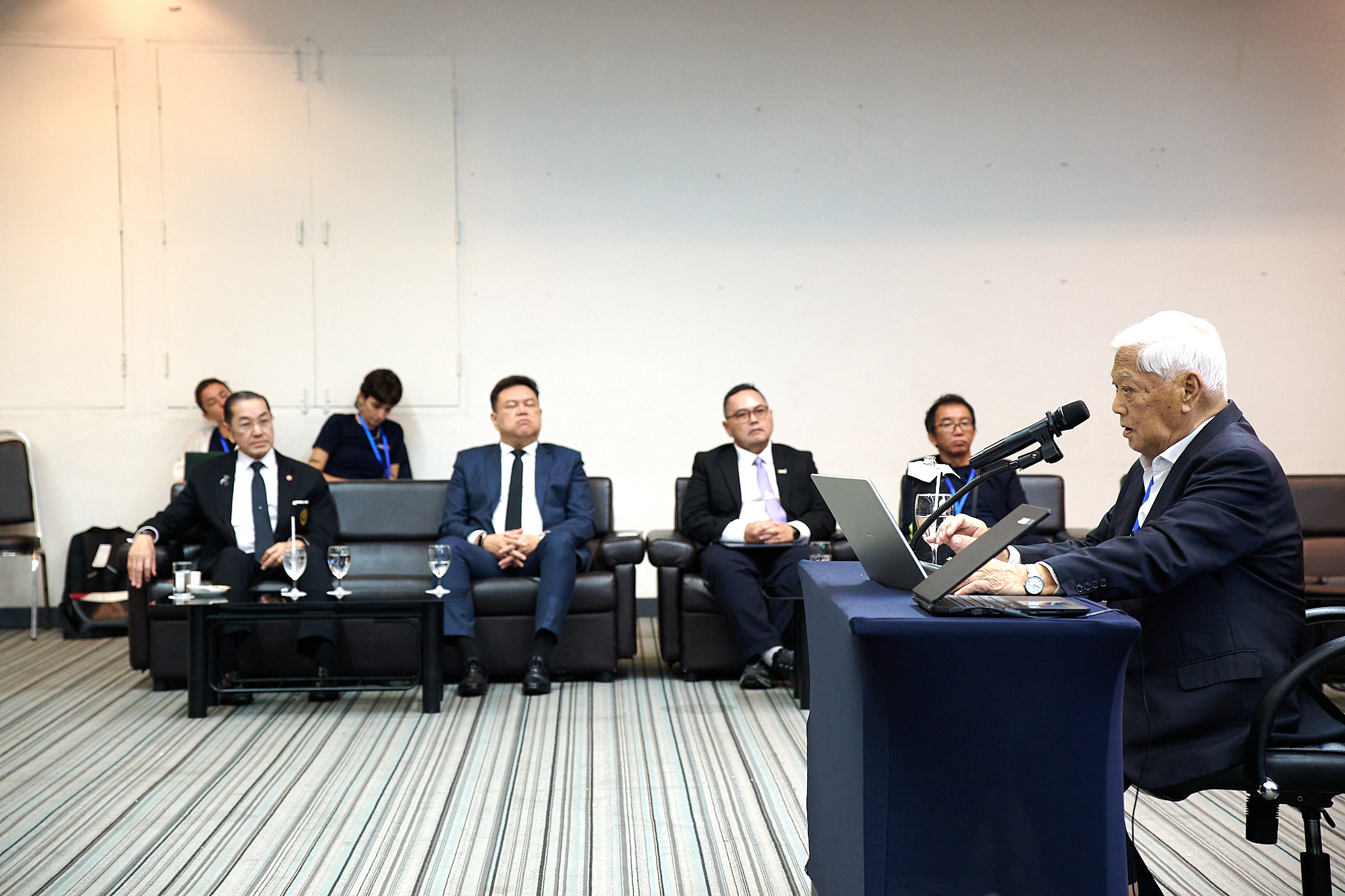
Dr. Chayan said in his remarks that the conference is being held five years after the coup in Myanmar, raising the question of where the country would go from here. He added that this question had become the basis for this year’s theme, “Between Crisis and Possibility: Voices for Myanmar’s Transformation.”
Through various sub-themes and dozens of papers, Dr. Chayan hoped that participants would be able to think forward about how, between crisis and possibility, voices for Myanmar’s transformation could emerge. He cautioned, however, that most of the papers focused on current situations and problems, and urged participants to “contribute” more to make the conference meaningful and helpful in answering the key question.
Myanmar, Dr. Chayan said, has been in what academics call “a prolonged interregnum.” The region’s noted development scholar explained that while the old regime is dead, the new regime has not yet emerged.
The coup produced not simply a political crisis but a deeper breakdown of the old political order. Yet the new order that many people have hoped for, based for instance on federalism, inclusiveness, and respect for Myanmar’s diversity, has not yet become consolidated. Myanmar, therefore, remains between the old order and the new regime. The former cannot fully restore itself, while the new political community has not yet been reconstituted, he remarked.
But Myanmar’s interregnum should not be understood only as paralysis or tragedy, the scholar cautioned, stressing that it is also where possibility becomes important.
This is because the weakening of the established political order also opens political space in which people can reconsider such fundamental questions as: What kind of country should Myanmar become? Who belongs to it? How should different ethnic, religious, territorial, and political communities live together? What should constitute legitimate authority? And what kinds of relations between communities and the state should replace military domination?
“This is what we would like to hear — your discussions, your contributions on how we can get out of this interregnum. This will shift our emphasis from an institution design to “a political imagination”,” said Dr. Chayan.
Dr. Chayan explained that the federal constitution, elections, administrative structures, and territorial arrangements are important, but they cannot by themselves create a political community. Before or alongside the construction of institutions, people must begin to imagine that they belong to a political world that they are willing to construct together, the scholar noted.
Political imagination in this sense, he further noted, does not require everyone to hold the same ideology. Given such examples as Karenni, Karen, Kachin, Chin, Mon, Rakhine, and Bamar communities in Anya, Yangon activists, women’s organisations, and many others, he said they may have different historical experiences and political aspirations. The crucial question is whether these different components can coexist within a broader imagination of a shared political future, the scholar remarked.
“A political community, in my view, does not necessarily arise because everyone becomes identical and agrees on everything. It can emerge when, through struggles, we begin to recognize something in one another: opposition to military domination, demands for identity and dignity, local autonomy, equality, justice, protection of land and resources, or the right to participate in decisions affecting one’s community. These connections may gradually create a sense of “we” without eliminating differences.
“The important point, however, is that such a “we” does not yet exist in Myanmar. It should, therefore, not be assumed. It is precisely the political problem of the interregnum,” said Dr. Chayan.
Dr. Chayan raised a critical question that should be asked: How can the prolonged interregnum be transformed from a condition of fragmentation, violence, and uncertainty into a moment in which the diverse people of Myanmar can imagine themselves as participants in a new political community?
This, he said, makes political imagination itself a political process. It can develop through experiences of cooperation, mutual recognition, collective suffering, resistance, local governance, dialogue, and everyday practices of living together. Some of these processes are already occurring from below, but they remain fragmented, uneven, and sometimes contradictory, Dr. Chayan remarked.
“So, I think, this gives much greater meaning to the title of this conference. For Myanmar’s prolonged interregnum, “Between Crisis and Possibility”: Crisis refers to a disintegration of the old political order, fragmented authority, violence, displacement, and the inability to act to establish a legitimate national order. Possibility refers to the optimism that a new order will emerge through a historical opening in which new relationships, identities, institutions, and understandings of a political community can be imagined.
“So, the way out of this political interregnum is not simply a defeat of one political actor or the drafting of another constitution. It requires a difficult construction of a new “political imagination”, a shared sense of political belonging capable of embracing profound differences.
“This is the message that we would like to ask you to think through: How can this conference not only talk about the past problems and the current problems, but also about how we can go forward? What is the way out of this political interregnum?” challenged Dr. Chayan as he closed his remarks.


Professor Dr. Surakiart Sathirathai, Chairman of the Asian Peace and Reconciliation Council and former Deputy Prime Minister and Foreign Minister of Thailand, added during his speech that platforms such as the ICBMS are a very important part of diplomacy, which he described as “education diplomacy.”
The theme of this conference, he added, is both timely and meaningful, as it is convened at a moment when Myanmar continues to face profound challenges and uncertainties, while the wider region is also confronting complex issues that transcend national boundaries. These include continued conflicts in Myanmar, geopolitical competition, environmental degradation and climate change, migration and displacement, questions of governance, justice, humanitarian assistance, human security, and human rights, among others.
These challenges, the noted diplomacy expert noted, require a deeper understanding, reliable evidence, and constructive engagement among scholars and practitioners from different countries and disciplines.
“As for my early work on Myanmar as Chairman of the APRC, my work in the past years through “quiet diplomacy” on Track 2 has tried to promote “inclusive peace dialogues” between the government of Myanmar and over 40 opposition groups,” Dr. Surakiart shared his experience, adding he personally met with representatives of all parties to the conflict to understand each party’s concerns, positions, constraints, impacts from the continued fighting, and also from gross violations of human rights in Myanmar.
“The economic and social problems in Myanmar, the border problems with Thailand, and the impacts on the region cannot be solved without inclusive dialogue and sustainable peace in Myanmar.”
Dr. Surakiart urged the participants to seriously discuss how inclusive dialogue can take place and suggested that the dialogue should begin with less politicised issues, such as the reduction of violence and humanitarian assistance to all parties affected by the fighting in Myanmar.
“Down the road, health and food security, the effects of the climate crisis, and migration can be discussed, leading all the way to the need for constitutional amendments or forms of government such as federalism, federal democracy, or democratic federation, if you will.
“Inclusive dialogue can begin with issues that can be discussed without too much political confrontation, to find what you may call a common denominator, or what ASEAN countries call “the lowest hanging fruit”, to move the agendas forward to more difficult ones. Quiet diplomacy can be used when and where appropriate to create confidence among parties to the conflict.
“With the existing trust deficit among certain parties to the conflict, I believe that the confidence-building process is badly needed. Academics, researchers, and experts can provide facts, information, and scientific data to de-escalate possible emotions that may erupt during the dialogue,” said Dr. Surakiart.
Read more of Professor Dr. Surakiart’s speech at Perspectives.

Indie • in-depth online news agency
to “bridge the gap” and “connect the dots” with critical and constructive minds on development and environmental policies in Thailand and the Mekong region; to deliver meaningful messages and create the big picture critical to public understanding and decision-making, thus truly being the public’s critical voice