
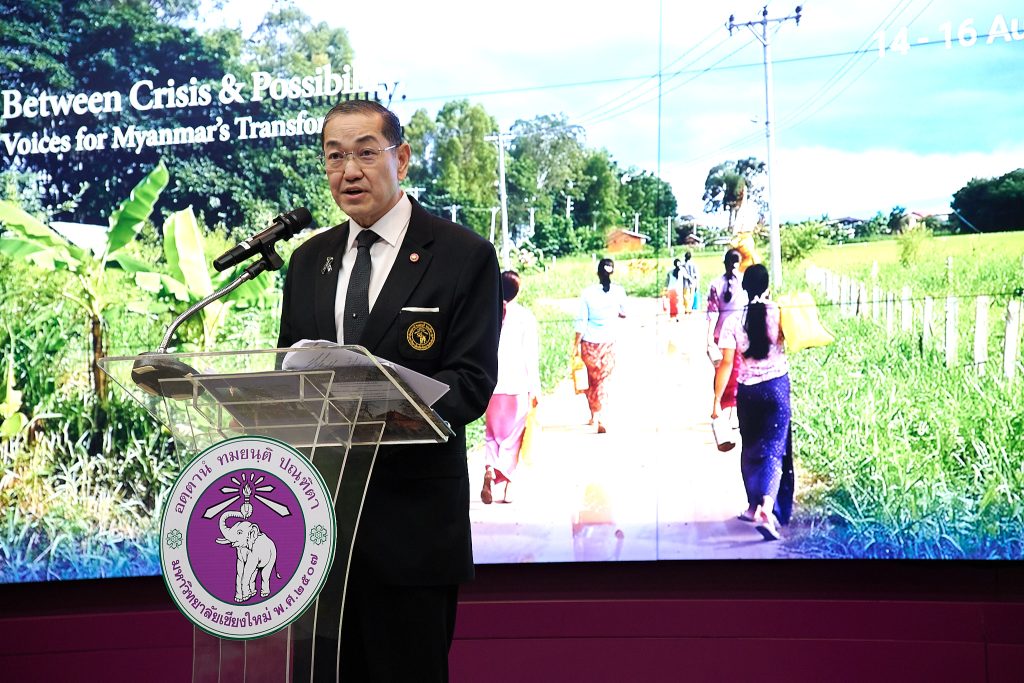
Distinguished keynote speakers, scholars and researchers, representatives of civil society organizations, students, distinguished guests, ladies and gentlemen,
Good morning.
It is my great pleasure to welcome you all to Chiang Mai University and to the 5th International Conference on Burma/Myanmar Studies, held under the theme “Between Crisis & Possibility: Voices for Myanmar’s Transformation.”
First, I would like to express my sincere appreciation to the Regional Center for Social Science and Sustainable Development (RCSD), the Faculty of Social Sciences, Chiang Mai University, as well as all partner organizations and supporters, for their commitment and hard work in organizing this important international gathering. I highly commend Chiang Mai University in being a platform for academics and researchers to present their findings and exchange of views on issues which are important for Myanmar and the region, and on issues which the public may not have access to fact and information easily.
I am delighted to see participants from many countries and institutions joining us here in Chiang Mai. Your presence reflects the continued importance of Myanmar Studies as a field of scholarship and as a platform for regional and international engagement.
The theme of this conference is both timely and meaningful. We meet at a moment when Myanmar continues to face profound challenges and uncertainties, while the wider region is also confronting complex issues that transcend national boundaries. These include continued conflicts in Myanmar, geopolitical competition, environmental degradation and climate change, migration and displacement, public health concerns, educational disruption, and questions of governance, justice, humanitarian assistance, human security, and human rights.
These challenges require deeper understanding, reliable evidence, and constructive engagement among scholars and practitioners from different countries and disciplines.
Distinguished Participants,
I have looked at the sub-themes of this conference with great interest. They are all important topics to help understand Myanmar situation and social transition at present. As for my own work on Myanmar as Chairman of the Asian Peace and Reconciliation (APRC) in the past years, through quiet diplomacy, APRC as track 2 has tried to promote inclusive peace dialogues between the government of Myanmar and over 40 opposition groups. I met representatives of all parties to the conflicts to understand each party’s concern, their positions, their constraints and impact from the continued fighting and gross violation of human rights in Myanmar.
The economic and social problems in Myanmar, border problems with Thailand and the impact on the region cannot be solved without inclusive dialogue and sustainable peace in Myanmar. I therefore would like to urge all of you, all of us in track 2, civil society, to deliberate seriously how inclusive dialogue can take place.
Not only Myanmar military that must embrace this approach, all parties to the conflict should be invited to present their positions in the dialogue. Perhaps the inclusive dialogue should begin with issues which are less politicized, such as reduction of violence and humanitarian assistance to all parties affected by the fighting in Myanmar. On humanitarian assistance, the regional Red Cross and Red Crescent societies and ASEAN Coordinating Center for Humanitarian Assistance on Disaster Management or AHA of ASEAN can play a constructive role.
Other assistance from other Asian and western countries can also be contemplated. Down the road, the health and food security, the effect from climate crisis and migration can be discussed, leading all the way to the need for constitution amendment, forms of government such as Federalism, Federal Democracy or Democratic Federation.
Inclusive dialogue can begin with issues that can be discussed without too much political confrontation to find common denominator, or what ASEAN calls “lowest hanging fruit” and move the agenda forward to a more difficult one.
The quiet diplomacy can be used where and when appropriate to create confidence among parties to the conflict. With existing trust deficit among certain parties to the conflict, confidence building process is needed. Academics, Researchers, Experts can provide facts, information and scientific data to de-escalate possible emotion erupted during the dialogue.
Impartial institutions in the region can play a constructive role in bridging differences and stabilize the confidence building process. Trusted connectors in the region and beyond either track 1, 1.5 or track 2 should put their heads together, compare notes in their attempt to convince all parties to accept inclusive dialogue. In other words, there is also a need to mediate positions among different mediators.
It is my fervent hope that with all of you gathered here today, we can work together to create inclusive dialogue for sustainable peace in Myanmar. With like-minded countries, like-minded communities in the region and beyond, perhaps a “Friends of Myanmar Group” at different level can be established to help Myanmar people having peaceful and prosperous lives.
It is high time that violence on the ground is reduced and finally terminated. It is high time that the loss of lives and properties impacted by armed conflict to stop, it is high time for human rights are no longer grossly violated and it is high time for Myanmar people to be able to contribute to economic development in Myanmar and in the region.
Ladies and Gentlemen,
I hope that this conference will provide a meaningful platform for the exchange of ideas, knowledge, and experiences. I also hope that the discussions over the coming days will contribute to a better understanding of the region’s challenges and opportunities, while fostering new partnerships and future collaboration for sustainable peace and development in Myanmar.
On behalf of the Chiang Mai University Council, I warmly welcome all participants and wish you a productive discussion and that the conference is crowned with success.
Thank you for your kind attention.

Professor Surakiart is Chairman of the Chiang Mai University Council and Chairman of the Asian Peace and Reconciliation Council.