
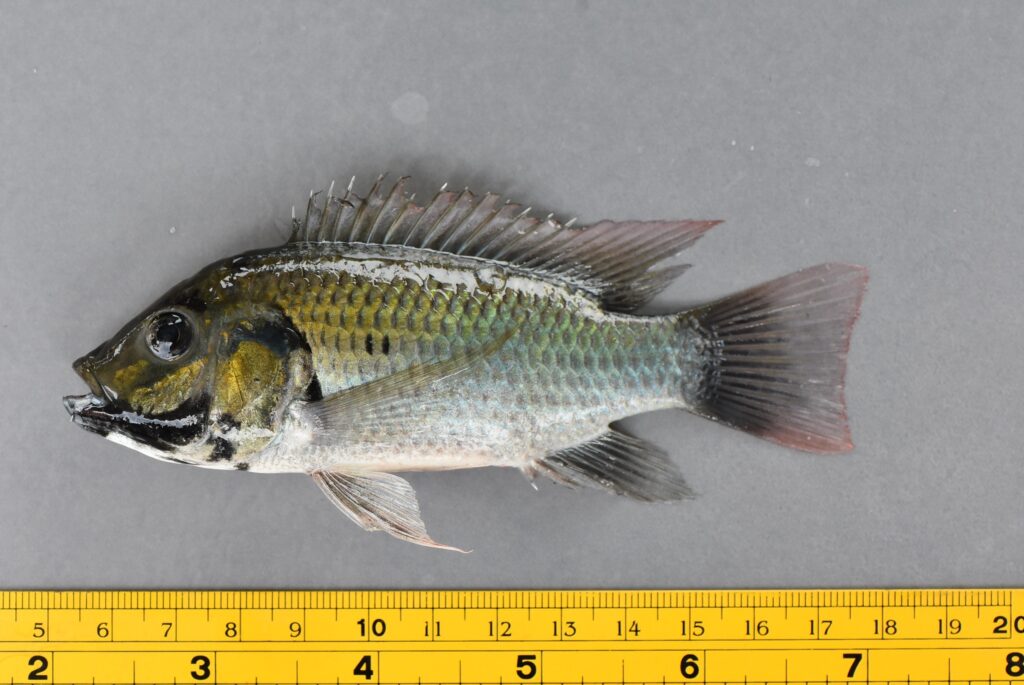
The Central Administrative Court has delivered its verdict today in a case concerning the outbreak of Blackchin tilapia, ordering the Department and relevant agencies to take action to resolve the problem within 180 days following the final verdict
The case was filed by at least 54 residents from affected areas in late 2024 against the Department and 17 other relevant agencies and authorities. Charoen Pokphand Foods PCL requested to intervene in the case.
The Court ruled that the Department had been negligent in performing its duty to oversee research involving the fish conducted by the company. It ordered the Department and relevant agencies to take action in accordance with their powers and duties under the Royal Ordinance on Fisheries B.E. 2558 (2015) to control, prevent, resolve, and suppress the outbreak of blackchin tilapia in affected areas. It also ordered them to declare outbreak zones and provide assistance to affected victims in emergency cases.
The Central Administrative Court said the department already knew that granting the company permission to bring blackchin tilapia, an alien fish species, into the country for research purposes could affect native aquatic species.
However, the facts showed that, after permission was granted to the company to import the fish under Permit No. 41/2554, dated 12 November 2010, the department, through its Director-General, who was the 2nd defendant, never conducted any control or inspection of the research involving the importation of the fish to determine whether it was carried out in accordance with the stated purpose of the importation.
The Court stated that this constituted a failure to perform the duty to prevent and control alien aquatic animals as prescribed by the Fisheries Act B.E. 2490 (1947), which was the law in force at the time.
When the fish outbreak subsequently occurred between 2012 and 2016, regardless of whether the problem was caused by the actions of the company, the department had the power and duty to address it under the Royal Ordinance on Fisheries B.E. 2558 (2015).
Although the department had introduced several measures to address the problem, including an action plan covering 2024 to 2027, and had continuously implemented urgent measures that had reduced the fish abundance in water sources, the success of those urgent measures was considered only an initial achievement.
As long as the measures under the action plan had not been fully implemented and the problem had not completely ceased or reached a situation in which ecological balance had been restored, the department remained under a duty to address the problem in accordance with its powers and duties under the Royal Ordinance, the Court said.
Regarding the declaration of areas affected by the outbreak as emergency victim assistance zones, in order to provide remedies to the plaintiffs, the Court found that the department and its director general at that time were aware of the criteria for assisting disaster victims, as shown by a letter from the Comptroller General’s Department through its director general responding to their inquiry.
They had also issued a letter requesting provincial governors to act in accordance with those criteria. In addition, the Department of Disaster Prevention and Mitigation through its director general had issued a letter informing provincial governors of the criteria and guidelines for declaring emergency victim assistance zones, based on a resolution of the working group responsible for considering the framework for assistance criteria.
However, the Governor of Samut Songkhram province—which was reported to have been among the areas hardest hit by the outbreak—had not issued an announcement declaring Amphawa, Mueang Samut Songkhram, and Bang Khonthi districts as emergency victim assistance zones to provide assistance to the plaintiffs and other affected members of the public.
The Court therefore found that there had been a failure to perform a duty required by law and an unreasonable delay in doing so.
However, regarding the request by the 54 plaintiffs for the 18 defendants to consider seeking compensation from the company and relevant parties for damages caused to the state by the fish outbreak under Section 97 of the Enhancement and Conservation of National Environmental Quality Act B.E. 2535 (1992), the Court held that such action would not directly resolve or remedy the grievances or damages suffered by the 54 plaintiffs.
They were therefore not considered persons entitled to bring a lawsuit on this issue, the Court ruled.
The Court therefore ordered the department to take action, in accordance with its powers and duties under the Royal Ordinance on Fisheries B.E. 2558 (2015), to control, prevent, resolve, and suppress the outbreak of blackchin tilapia in affected areas, in accordance with the action plan and other necessary measures on an ongoing basis.
The Ministry of Agriculture and Cooperatives (the 5th defendant) and the Minister of Agriculture and Cooperatives (the 6th defendant) were ordered to jointly supervise and provide the necessary resources to ensure that the department effectively carries out its powers and duties. These actions must be completed within 180 days from the date the case becomes final, the Court ordered.
The Court further ordered the Minister of Interior (the 17th defendant) to consider instructing the Governor of Samut Songkhram to issue an announcement declaring the areas of Amphawa, Mueang Samut Songkhram, and Bang Khonthi districts in Samut Songkhram province as emergency victim assistance zones.
This would allow the province to consider providing assistance to all 54 plaintiffs who suffered damage from the fish outbreak in accordance with the criteria and guidelines for declaring an emergency victim assistance zone under the Ministry of Finance Regulations on Advance Money for Emergency Victim Assistance B.E. 2562 (2019). This must be completed within 90 days from the date the case becomes final, the Court ordered.
The Court also dismissed the complaints against some defendants, while dismissing other requests.
Some of the plaintiffs are also pursuing a class-action lawsuit against the company, representing more than 1,400 fishers affected by the outbreak. The case is regarded as the largest environmental lawsuit of its kind to date. The company is also embroiled in another libel case involving BioThai Secretary-General Witoon Lianchamroon, who had raised concerns about and exposed the outbreak.
Also read: Series of legal action taken in Blackchin tilapia fish invasion case

Indie • in-depth online news agency
to “bridge the gap” and “connect the dots” with critical and constructive minds on development and environmental policies in Thailand and the Mekong region; to deliver meaningful messages and create the big picture critical to public understanding and decision-making, thus truly being the public’s critical voice