
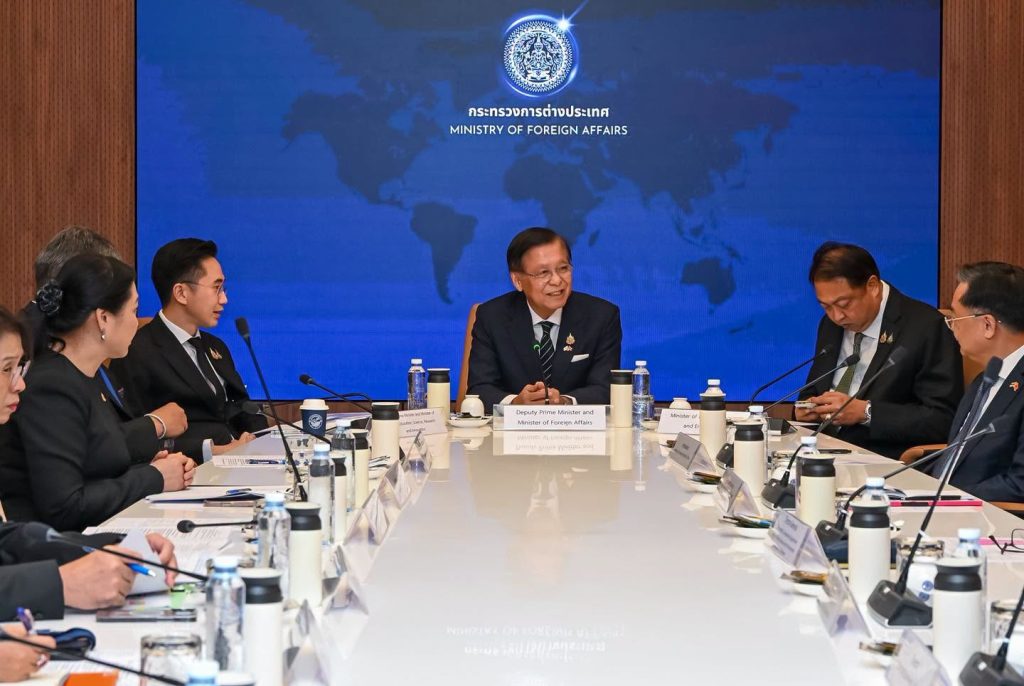
Representatives of the three countries met ahead of the first meeting of their joint working group on water quality management yesterday to establish a framework for discussions on jointly addressing transboundary toxic river pollution caused by unregulated mining in Myanmar. The meeting is scheduled to take place today and tomorrow amid the escalating crisis
Ahead of the official meeting of the Joint Working Group on Water Quality Management in Boundary and Transboundary Rivers, Deputy Prime Minister and Minister of Foreign Affairs H.E. Sihasak Phuangketkeow, Deputy Prime Minister and Minister of Higher Education, Science, Research and Innovation Prof. Dr. Yodchanan Wongsawat, and Minister of Natural Resources and Environment Suchart Chomklin received a courtesy call from the permanent secretaries of the natural resources and environment ministries from Thailand and Myanmar as well as their respective delegations at the Ministry of Foreign Affairs.
They also held discussions at the ministry in an attempt to establish a framework for addressing the problem jointly ahead of the officials’ JWG meeting. Participants included China’s Ambassador to Thailand, Zhang Jianwei, Chinese officials, representatives of the Embassy of Myanmar, and representatives from Shan State.
Prof. Yodchanan, also in his capacity as chair of the Disaster Prevention and Mitigation Committee, which was appointed by Prime Minister Anutin Charnvirakul to oversee disaster management in northern Thailand, revealed at a press briefing that the Thai side had presented scenarios for the parties to discuss and work together to address the problem in the future.
Under his two-pronged approach, the Deputy Prime Minister has stepped up efforts to focus on tackling the issue at its source upstream, in cooperation with the parties concerned.


l Photos: Bangkok Tribune
The discussion framework
First and foremost, he said, the Thai side had presented participants with a set of facts showing that the toxic chemicals did not originate naturally but came from mining activities, a point acknowledged by the participants. Their source, he added, was identified as areas in Shan State, Myanmar, another point that no one disputed. This suggested that the parties accepted the need to work together to address the problem at its upstream source.
Prof. Yodchanan further revealed that discussions continued during the meeting, with mines identified and divided into two main categories for future management: government-controlled mines and so-called “private” mines. He later explained that the latter referred to mines located in territories controlled by ethnic groups or non-state actors.
For mines under the control of the Myanmar government, technical support to improve their operations will be provided by Thai and Chinese experts. Regarding the “private” mines, Prof. Yodchanan said the Thai side had proposed a traceability framework to the Chinese Ambassador to ensure that mining activities comply with acceptable standards. This mechanism would help the Myanmar government take the process a step further, as mining operators upstream would have to verify whether their operations meet the required standards before exporting their minerals, he added.
Thailand expected this approach to serve as a framework for further discussions on the way forward. The Chinese Ambassador acknowledged and understood the proposal, Prof. Yodchanan said.
“I feel that (today’s discussion) marks a positive step towards addressing the problem at its source,” said Prof. Yodchanan at the press briefing yesterday.
During the Q&A session, Prof. Yodchanan further explained that efforts to address the problem at its source, involving both mines under the Myanmar government’s control and “private” mines, would proceed in parallel.
He added that Thailand aims to inspect the mines individually to identify and classify them for improvement. No specific timeframe has yet been set. Prof. Yodchanan said he had told participants that Thailand needed to examine the mines one by one. During inspections, experts would need to identify the chemical fingerprints of the toxic substances. Once they identified the contaminants, they could design appropriate filtration systems to remove them.
“Both Chinese and Thai laboratories are working side by side on this because China needs to help as well. So, we must determine what kinds of filters are required. It’s not as simple as installing one filter and filtering everything. We must examine the actual site. We have also discussed collecting samples, as suggested by our Environment Ministry,” said Prof. Yodchanan.
Prof. Yodchanan also revealed that he had called for the temporary closure of the mines for six months, adding that this was the ultimate goal sought by local residents. For the time being, however, the working group would classify and prioritise the mines according to which could comply with the requirements and which fell outside the Myanmar government’s control. The best approach would be to put forward this proposal.
“Wherever they can manage the water by themselves, let them manage it. Whatever else needs to be done, we will do,” said Prof. Yodchanan.
He also explained that the same approach would be applied to mines controlled by non-state actors. He acknowledged that this would undoubtedly be difficult, but said Thailand was determined to establish a standard approach: every mine must be inspected.
As a representative from Shan State attended the meeting, the Thai side also suggested that they inform the other parties about what they could and could not do.
China’s role and responsibility
At the same time, the Thai side asked Chinese authorities to consider introducing mechanisms to manage mineral value chains and ensure access to the cleanest possible mineral sources in Myanmar.
Prof. Yodchanan further elaborated on China’s role and responsibility in helping address the problem, although the country’s precise role and status in the process remain unconfirmed. China has denied involvement in the problem since it first emerged, despite growing calls for it to take responsibility for local residents affected by the pollution.
Prof. Yodchanan said he had discussed the challenge with the Chinese Ambassador. At the very least, the Thai side viewed that most rare earths extracted from “private” mines in Myanmar are eventually exported to China. China could therefore trace the minerals it uses or purchases back to their source mines and determine whether those mines comply with the required standards.
“This is something China can help with immediately, and it is a role that China and the international community can undertake together.
“If China manufactures products from these rare earths and other countries use Chinese equipment, it becomes a single supply chain. Today, we are trying to make the world aware that this issue needs to be managed right from upstream, and that is China’s role,” said Prof. Yodchanan.
Prof. Yodchanan conceded that there were many mines involved, making it impossible for Thailand to handle them all alone. For these private mines, the parties needed to consider how to provide mine operators with knowledge and guidelines and, if possible, financial support.
The Mekong-Lancang Cooperation framework was one possible avenue, although it would likely cover only the design stage. Funding for actual construction would have to come from other sources, as the Thai government could not use its own budget for this purpose, said Prof. Yodchanan. In fact, he added, the Thai government should be compensated rather than having to pay.
Asked whether the Chinese side had yet committed to the proposed framework, he said: “He (the Ambassador) attended the meeting with us. Actually, I understand that China is fully on board — he joined us and will also join the field visit. Implementation will have to be divided among several sectors, but right now there is good, positive momentum, for which I credit the MFA for working very hard to invite everyone to the table as well as the Environment Ministry.”
Work on the ground
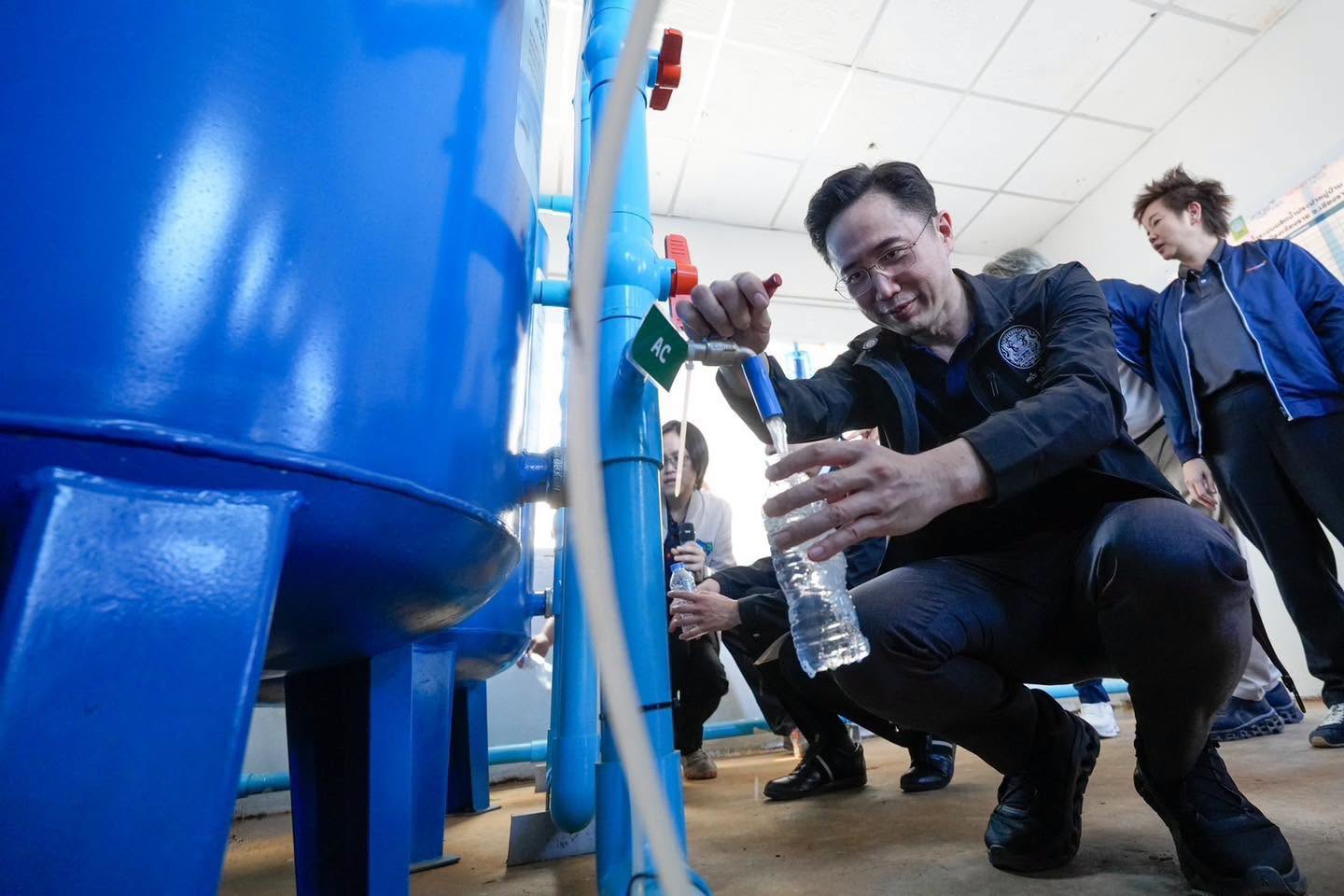
Prof. Yodchanan also outlined the other prong of his approach, saying that work on the ground in Thailand is already underway and that the government is trying to ensure its continuity. These efforts include water management and screening agricultural produce for contaminants. Regarding tap water, the Environment Ministry has added 10 groundwater drilling sites and community filtration systems, with both initiatives proceeding in parallel.
Relevant officials are also working on data by developing a risk map showing how the water could be used, when it would be suitable for agriculture, and the levels of contaminants present. Sensors would be installed, while screening for toxins in aquatic animals and fish would also proceed in parallel.
In areas where off-season rice cultivation takes place, the government planned to clear designated areas and establish so-called “sediment-trapping ponds”. It is also working to build public understanding so that everything will be ready before irrigation water was released next month, Prof. Yodchanan noted.
Regarding the import of chemicals used in mining, Prof. Yodchanan said the Prime Minister had already issued directives. The meeting made clear that, first, the Office of the National Security Council (NSC) will serve as a mechanism to prevent the export of precursor chemicals. Second, the Ministry of Industry and the Ministry of Commerce are reviewing existing laws to determine where bans could be enforced.
“If something needs to be banned, it must be banned, because this is harming Thai people,” he stressed.


l PM Anutin met with Chinese President Xi Jinping during the APEC summit in China. Credit: Thai Gov
The shared political will
Mr. Sihasak, meanwhile, noted during the press briefing that transboundary toxic river pollution is an important and urgent issue. He expressed satisfaction that the working group has been established to facilitate serious collaboration, as the problem affects not only Thailand but also Myanmar and needs to be resolved through mutual cooperation.
At the leadership level, Mr. Sihasak said there was shared political will to tackle the issue together. During Myanmar leader Min Aung Hlaing’s visit to Thailand (August 6–7), he reaffirmed Myanmar’s readiness to cooperate with Thailand.
Similarly, during Chinese Premier Li Qiang’s recent visit to Thailand (November 13–15), and subsequently when Thai Prime Minister Anutin Charnvirakul attended the APEC summit and met with Chinese President Xi Jinping (November 18–19), the Chinese side reaffirmed its commitment to supporting and assisting both countries in resolving the ongoing problem.
China, Mr. Sihasak said, is the driving force behind the Mekong-Lancang Cooperation (MLC), with water management serving as one of its core agenda items. During discussions with President Xi Jinping about reports of mining operations in Shan State involving Chinese private entities, the Chinese side affirmed that it would not support anything improper, illegal, or harmful to the environment and local communities.
“Consequently, (today’s meeting) underscored China’s prioritisation of the matter, demonstrated by the attendance of the Chinese Ambassador to Thailand,” stressed Mr. Sihasak at the press briefing.
Mr. Sihasak added that holding the November 25–26 meeting was a positive sign. The meeting would be co-chaired by the Permanent Secretary of the Ministry of Natural Resources and Environment and joined by the Chinese and Myanmar counterparts. Myanmar had also expressed its readiness to formulate an action plan.
“As the issue is multifaceted, a strong start is essential. It cannot be solved in a day or two, but requires a comprehensive approach from upstream to downstream, alongside technical support,” stressed Mr. Sihasak, adding that it was encouraging to see representatives from Shan State and experts from Yunnan participating.
Mr. Suchart, on the other hand, reaffirmed his support for the government’s plans led by Prof. Yodchanan, saying that everything proposed by both Deputy Prime Ministers was a good omen for starting from square one together.
He praised Prime Minister Anutin for engaging with the leaders concerned ahead of the working group’s meeting and urged the public to trust that the government was working in an integrated manner. His ministry, he added, would do its part through the Pollution Control Department, which would take the lead in addressing issues related to management plans, in cooperation with the Ministry of Interior and the provincial governors concerned.
Following the joint working group meeting, the ministers plan to visit Chiang Rai Province to follow up on the meeting’s outcomes and advance their implementation. The Foreign Affairs Minister also plans to invite senior representatives from Myanmar to join a field visit to the border area in the near future, according to the Ministry of Foreign Affairs.
Locals’ demands
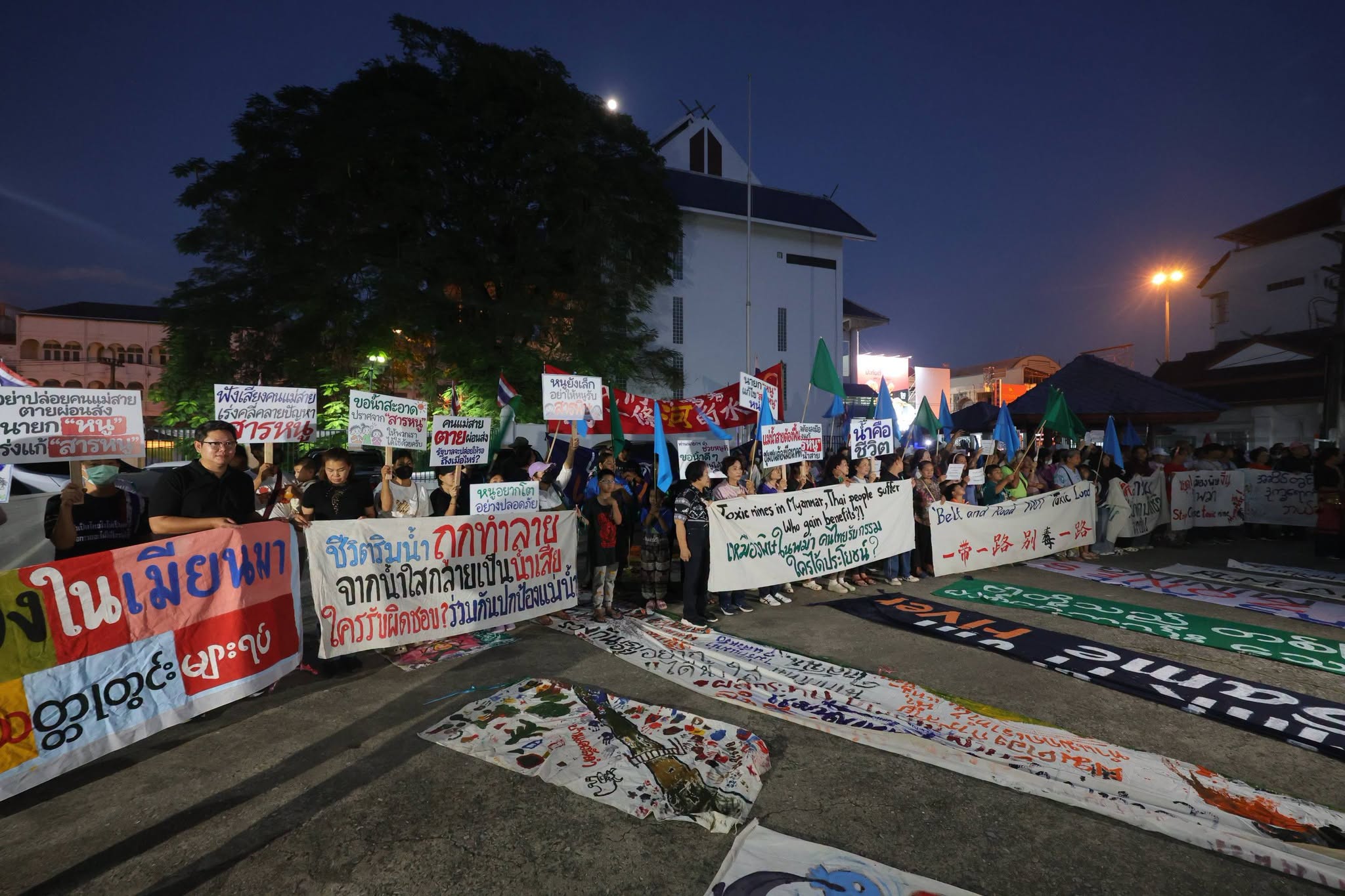
Earlier, on Sunday afternoon of November 22, hundreds of residents from areas affected by transboundary toxic river pollution in Chiang Rai and Chiang Mai gathered near the Mae Sai–Tachileik border checkpoint to demand that the government step up efforts to address the issue.
Residents have been suffering from pollution caused by unregulated mining activities upstream in Myanmar for nearly two years. The pollution has since spread further downstream to other provinces along the Mekong River, with additional sources of contamination identified, including mining activities in Lao PDR.
Residents have been demanding that the government introduce timely and proportionate measures and policies to address the issue since it first emerged in early 2025. At the time, some residents in Tha Ton subdistrict, Mae Ai district, Chiang Mai, were reported to have developed unusual symptoms after coming into contact with the Kok River. Residents subsequently took to the streets in their community for the first time in March to protest against upstream mining activities.
Their calls had largely gone unanswered until the issue resurfaced in Mae Sai early this month, when the Sai River turned unusually turbid and arsenic contamination reached an exceptionally high level — more than 25 times the WHO guideline of 10 micrograms per litre.
Prime Minister Anutin had said he had sought talks with Chinese leaders to enlist their help, as many believe that several Chinese investors are behind the mining activities.
He also convened a meeting of the National Disaster Prevention and Mitigation Committee on November 21 to coordinate measures to address the problems on various fronts. These included integrating fragmented data, implementing mitigation measures to address on-the-ground issues such as toxic contamination in water, soil, and food, and strengthening cooperation and negotiations with neighbouring countries, particularly Myanmar.
Prof. Yodchanan also visited Mae Sai to inspect the situation and meet residents to hear their demands.
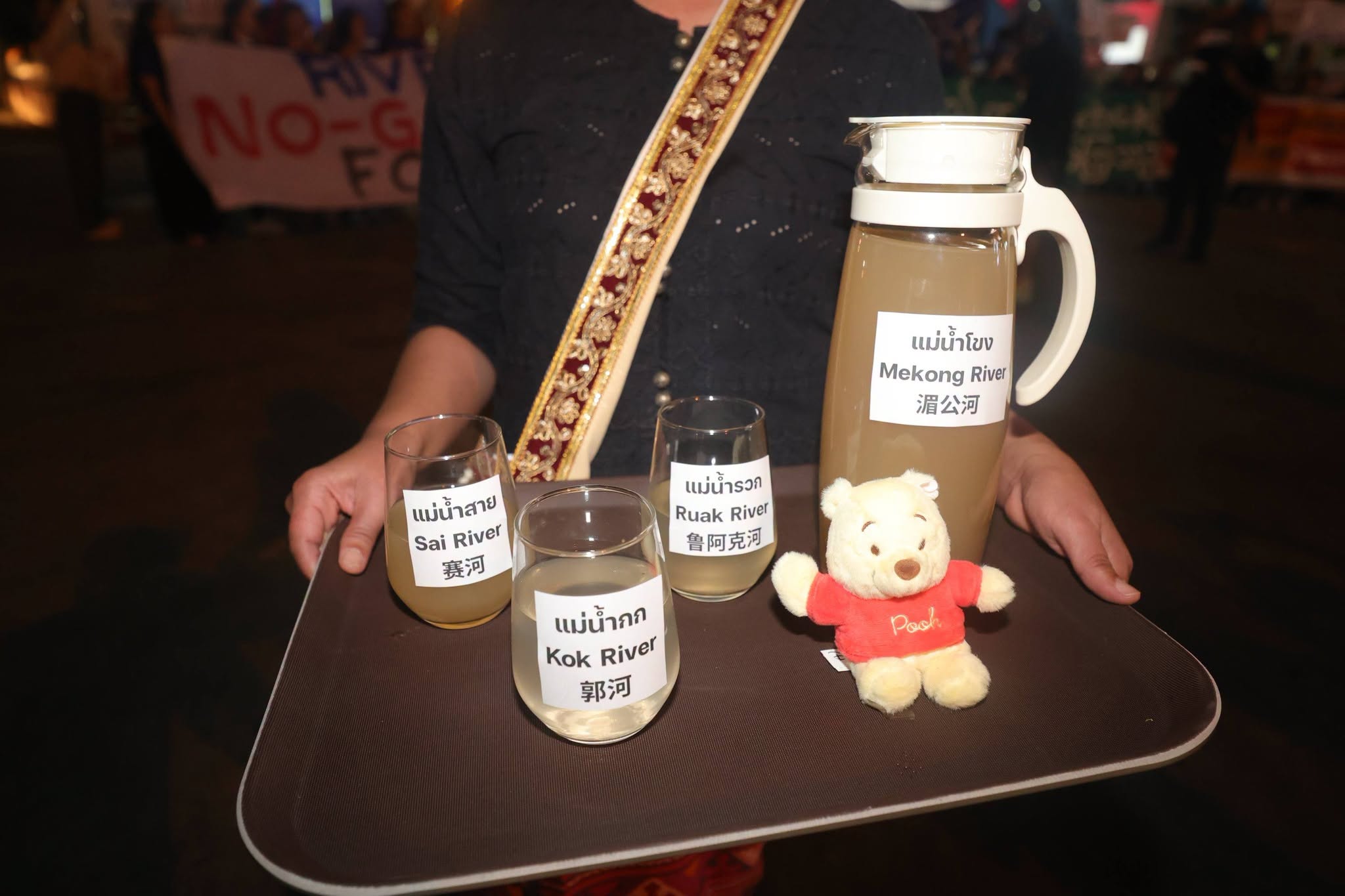
The residents, organised under the banner of the People’s Network for the Protection of the Kok, Sai, Ruak, and Mekong Rivers, listed at least 17 concerns, ranging from violations of their rights and impacts on local communities to the lack of proper mitigation measures, unfulfilled demands submitted to the national policy committee, and insufficient cooperation from Myanmar and China.
They called on the government to address these challenges in a timely and proportionate manner. (Read the full statement at: https://www.facebook.com/share/p/1F6UHPKx62/.)
Prof. Yodchanan received their letter on behalf of the government and vowed to address both the immediate challenges faced by local residents and the root causes of the problem. He also pledged to draw on his scientific expertise and knowledge to drive efforts to resolve the issue.
To show the government’s openness to work with people, some representatives in the network were invited by the Deputy Prime Minister to attend and observe the JWG meeting today and tomorrow.
Also read: SPECIAL REPORT SERIES: The Poisoned Rivers: From gold to rare earth, unregulated mining in Myanmar poisons the Mekong and its tributaries in Northern Thailand/ PHOTO ESSAY: Living in Fear

Indie • in-depth online news agency
to “bridge the gap” and “connect the dots” with critical and constructive minds on development and environmental policies in Thailand and the Mekong region; to deliver meaningful messages and create the big picture critical to public understanding and decision-making, thus truly being the public’s critical voice