
As Thailand faces growing challenges from transboundary toxic river pollution caused by unregulated upstream mining in Myanmar and other countries, including Lao PDR, engaging with the Lao government could offer a way to address harmful mining practices in Laos while also providing valuable lessons and insights for Thailand’s future engagement with the Myanmar government, write Brian Eyler, Director of the Stimson Center’s Southeast Asia Program, and Madelyn MacMurray, a graduate of the University of Wisconsin-Madison’s Nelson Institute for Environmental Studies
Since March 2025, civil society networks and communities in Chiang Mai and Chiang Rai Provinces have worked tirelessly to draw attention to transboundary mining pollution from Myanmar into Thailand via the Kok and Sai-Ruak Rivers. These rivers and surrounding farmlands consistently test higher than safe standards for arsenic and other heavy metals.
To date, Bangkok has yet to take meaningful action with the Myanmar government and ethnic armed groups who govern the mines to stem the flow of contamination. However, the scope and the scale of the issue of transboundary water pollution to Thailand is much bigger than the pollution coming out of Myanmar. Evidence suggests more than 200 mines on tributaries of the Mekong in Laos are polluting the 500 kilometer stretch of the Mekong from Loei to Nakhon Phanom, where millions of Thai people live.
Taking up this issue with the Lao PDR government, a closer neighbor to Thailand’s government than Myanmar, could curb bad mining practices in Laos, and the learning process could provide valuable insights for Thailand’s engagement with the Myanmar government.


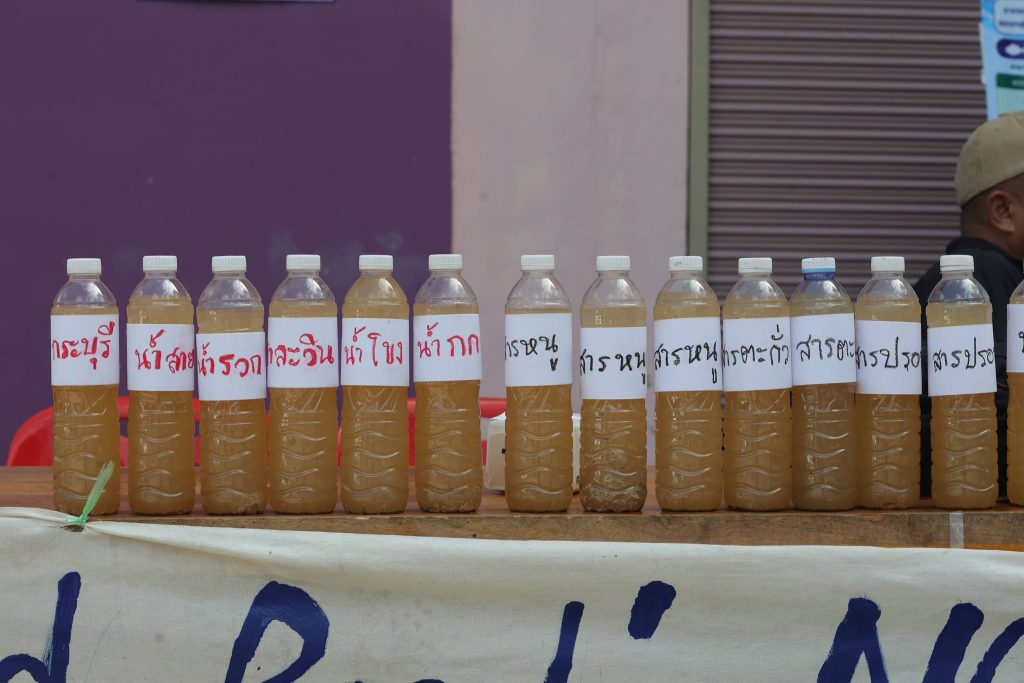
l Hundreds of northern residents under the banner of the People’s Network for the Protection of the Kok, Sai, Ruak, and Mekong Rivers held a rally in Mae Sai district, Chiang Rai province yesterday. Photos: Bangkok Tribune
Stimson Center data shows 261 mines in Laos along twelve Mekong tributaries that flow directly to the Thai-Lao border. These mines are largely unregulated or underregulated, as satellite images of these mines show few-to-no mitigation efforts such as tailings ponds, suggesting that waste from these mines is discharged into the streams and rivers around the mines.
In 2021, the Laos government instituted a pilot mining scheme, which aimed to promote nationwide investment in natural resources as a way to earn quick income as the country recovered from the COVID-19 pandemic. Most of the mines in Laos have become operational since 2021, although some heap leach mining and alluvial mining activities were present prior to 2021.
Despite the suspension of new mining approvals beginning in 2024, Stimson data shows the number of unregulated mines in Laos increased by nearly 60% in 2025 and continues to increase in 2026.
In August, while researching a new book on the impacts of mining pollution in the Mekong region, we learned from Thailand’s Pollution Control Department in Nong Khai that August 2026 monitoring of Mekong River water quality found that arsenic levels in both water and sediment were higher than standard at most testing points across the provinces of Loei, Nong Khai, Bueng Kan, and Nakhon Phanom.
The arsenic level in sediment between Loei and Nong Khai was excessively high in August 2026. A repeat check in September 2026 found that arsenic levels in the Mekong had decreased but still exceeded the standard in all four provinces.
River shrimp, snails, and fish—consumed regularly by the people of Isaan—are substantial accumulators of metals in contaminated sediment. When the Mekong floods, its water and sediment are cast wide across tens of thousands of square kilometers of rich agricultural floodplains. When Thailand’s Royal Irrigation Department pumps water out of the Mekong in Isaan to relieve drought and irrigate farmland, contaminated sediment is channeled through those pumps potentially introducing heavy metals into agricultural products.
Villagers in Isaan first noticed changes to the river at the beginning of Laos’s mining boom. Long before blistered catfish caught in Chiang Rai became associated with transboundary pollution, fishers in Nong Khai first caught blistered catfish in 2021. Local people from four Isaan Provinces along the Mekong told us how they have long worried about the quality of the water they use to drink, bathe, and irrigate local gardens.
Residents in Isaan are discouraged from speaking up, citing the lack of appropriate action by officials to address mining pollution in Chiang Rai. Staffers at the Nong Khai pollution control department also cite a lack of resources to adequately test and respond to growing river and soil contamination.
The impacts of mining accidents that contaminate rivers are becoming apparent in Laos. On November 3, social media accounts captured unusually murky water on the Nam Song River near Vang Vieng and another possible spill in southern Laos. On November 4, the Laotian Times published a story about a Chinese-owned rare earth mine in Houaphanh Province that spilled discharge into a downstream river, the second such major accident at this mine in less than three years.
In Laos’s Houaphanh Province in August, we saw rare earth mines discharging waste directly into local streams and rivers. Local communities recounted fish kills and the death of livestock around the mines. One community leader said a significant portion of households became impoverished once mine operations began due to loss and contamination of their lands.
In October, at an ordinary session of the Lao National Assembly, parliamentarians voiced their concerns about the increasing impacts of mining pollution. Given the Thai parliament’s advocacy on transboundary mining pollution, we recommend parliamentary exchanges between Laos and Thailand as a way to share information and demonstrate a common cause. Civil society and academic networks can also reach across borders to increase communication and expose the scale of this issue.
For formal bilateral cooperation, we recommend swift, collaborative action to test water, sediment, and aquatic life in Laos’s tributaries that flow into the Mekong along the Thai-Lao border and the establishment of monitoring and mitigation mechanisms to improve transparency and accountability.
These efforts must be independent and free from political interference. The Lao PDR government should openly invite Thai actors to inspect mines located on Mekong tributaries and work with Thai authorities on improving mining regulations and inspection techniques. The Thai government should be motivated to provide investment and technical assistance to improve regulatory oversight and mitigation efforts around mines in Laos.
Crucially, we emphasise bilateral cooperation over regional cooperation to swiftly address this issue. While the Mekong River Commission has shown more interest in addressing transboundary water quality issues, the 1995 Mekong Agreement does not detail protocols for managing pollution issues, and the MRC has a very weak mandate to take action on Mekong tributaries where all of the mines in Laos are located.
Swift action can stem the flow of toxic contaminants into Thai territory along the Mekong. The cost of inaction threatens the health and livelihoods of millions and agricultural exports to markets around the world.
The article was first published on The Bangkok Post.

Brian Eyler is Director of the Stimson Center’s Southeast Asia Program.
Madelyn MacMurray is a graduate of the University of Wisconsin-Madison’s Nelson Institute for Environmental Studies.