
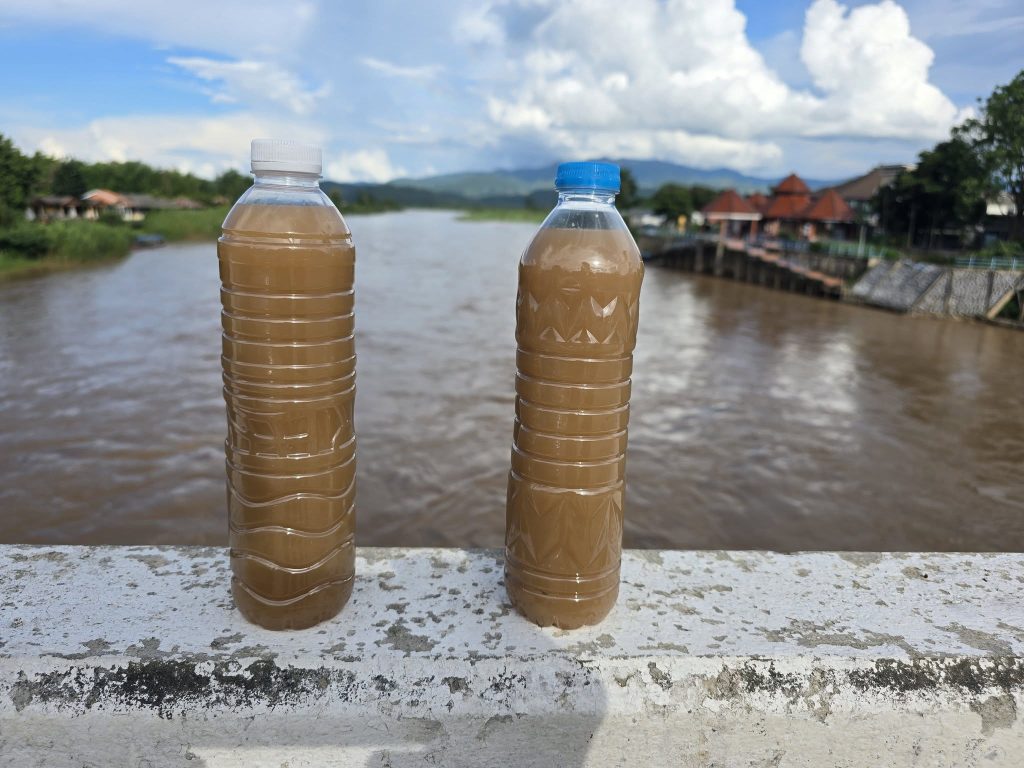
Prime Minister Anutin Charnvirakul has revealed the planned meeting after returning from his trip to China last week, while conceding that he did not raise the issue with Chinese leaders, even though China has been widely accused of being the principal cause of the pollution
Prime Minister Anutin Charnvirakul and his delegation visited China from July 16 to 20 at the invitation of Chinese Premier Li Qiang and met with China’s top leaders, including President Xi Jinping. The two countries signed at least 15 cooperation agreements across a wide range of sectors, including trade and technological innovation, and issued a joint statement. However, as reported by Thai PBS, PM Anutin did not raise the issue of transboundary toxic river pollution during his discussions with Chinese leaders, despite China having been widely alleged to be the principal cause of the pollution.
“I did not discuss this issue with China, as matters concerning neighbouring countries must first be resolved through direct dialogue among them,” PM Anutin said in response to reporters’ questions while attending a green economy event in Chonburi on July 22.
PM Anutin, however, said environmental issues were a key agenda item in discussions across all forums during his visit to China, covering topics ranging from the green economy and clean energy to environmentally friendly production processes and the reduction of greenhouse gas emissions.


l PM Anutin and his delegation met with Chinese leaders during his official visit to China on July 16-20, 2026. Credit: ThaiGov
The Prime Minister also revealed that Myanmar’s President, Senior General Min Aung Hlaing, will pay an official visit to Thailand on August 3–4. During the visit, the Thai government plans to raise the issue with its Myanmar counterpart in an effort to seek cooperation in addressing and resolving the problem.
“The government continuously places importance on addressing environmental issues, including toxic contamination in the Kok River in Chiang Rai. It is an issue that Thailand is following closely,” PM Anutin said, adding that the government also plans to discuss other matters, including field burning, drug trafficking, and broader security concerns.
The Prime Minister further said that Myanmar’s Foreign Minister had earlier met with him and acknowledged Thailand’s concerns ahead of President Min Aung Hlaing’s official visit. He also affirmed that the meeting would not be merely ceremonial but would focus on discussing issues of mutual benefit in a concrete and practical manner.
Anti-toxic river pollution campaigners and environmental advocates, however, remain unconvinced. They have threatened to visit Myanmar’s Consulate-General in Chiang Mai to submit a petition to Myanmar’s President during his visit to Thailand.
Dr. Suebsakun Kidnukorn, one of the key leaders of the People’s Network for the Protection of the Kok, Sai, Ruak, and Mekong Rivers, expressed disappointment with PM Anutin’s remarks. He said the Prime Minister should order the suspension of all mineral imports from Myanmar to strengthen Thailand’s bargaining position in the upcoming talks.
He also urged the government to raise the issue of all six rivers affected by mining activities in Myanmar during discussions with Myanmar’s leaders. In addition, he said the Prime Minister should visit the affected communities and areas to better understand the situation firsthand.
Thailand, he claimed, serves as a transit point for critical minerals from Myanmar destined for China while bearing the environmental consequences of the mining operations.
He added that the Myanmar government still lacks the seriousness and commitment needed to address the issue. Although a meeting between the Thai and Myanmar governments in late 2025 resulted in an agreement to establish a joint technical working group to monitor water quality, Myanmar has, to date, taken no action to implement the agreement, he said.
The Chinese government, meanwhile, is shifting responsibility for transboundary river pollution onto the affected countries, even though China is the primary beneficiary of mining operations in Myanmar, he pointed out.
China’s Rebuke
The network’s planned campaign is not the first. This month, the network’s anti-toxic river pollution campaigners and environmental advocates have staged protests twice in front of the Chinese Embassy in Bangkok and China’s Consulate-General in Chiang Mai, calling on the governments concerned to take the problem seriously and address it.
Since taking office, the Anutin government has done little to address the problem, and PM Anutin himself has rarely spoken publicly about the issue or responded to calls for him to take it seriously.
During his visit to China, the joint statement, as released by the Chinese Embassy in Bangkok, mentioned only near the end that China and Thailand, as the current co-chairs of the Lancang-Mekong Cooperation (LMC), would coordinate closely with other LMC member countries to convene the LMC Leaders’ Meeting at an early date.
The statement said the planned meeting was aimed at deepening regional cooperation in water resources management, connectivity, the cross-border economy, technological innovation, and the digital economy, while jointly addressing shared challenges, including transboundary air pollution, environmental issues, and transnational crime. However, it made no mention of the transboundary river pollution that China has been alleged to have contributed to.
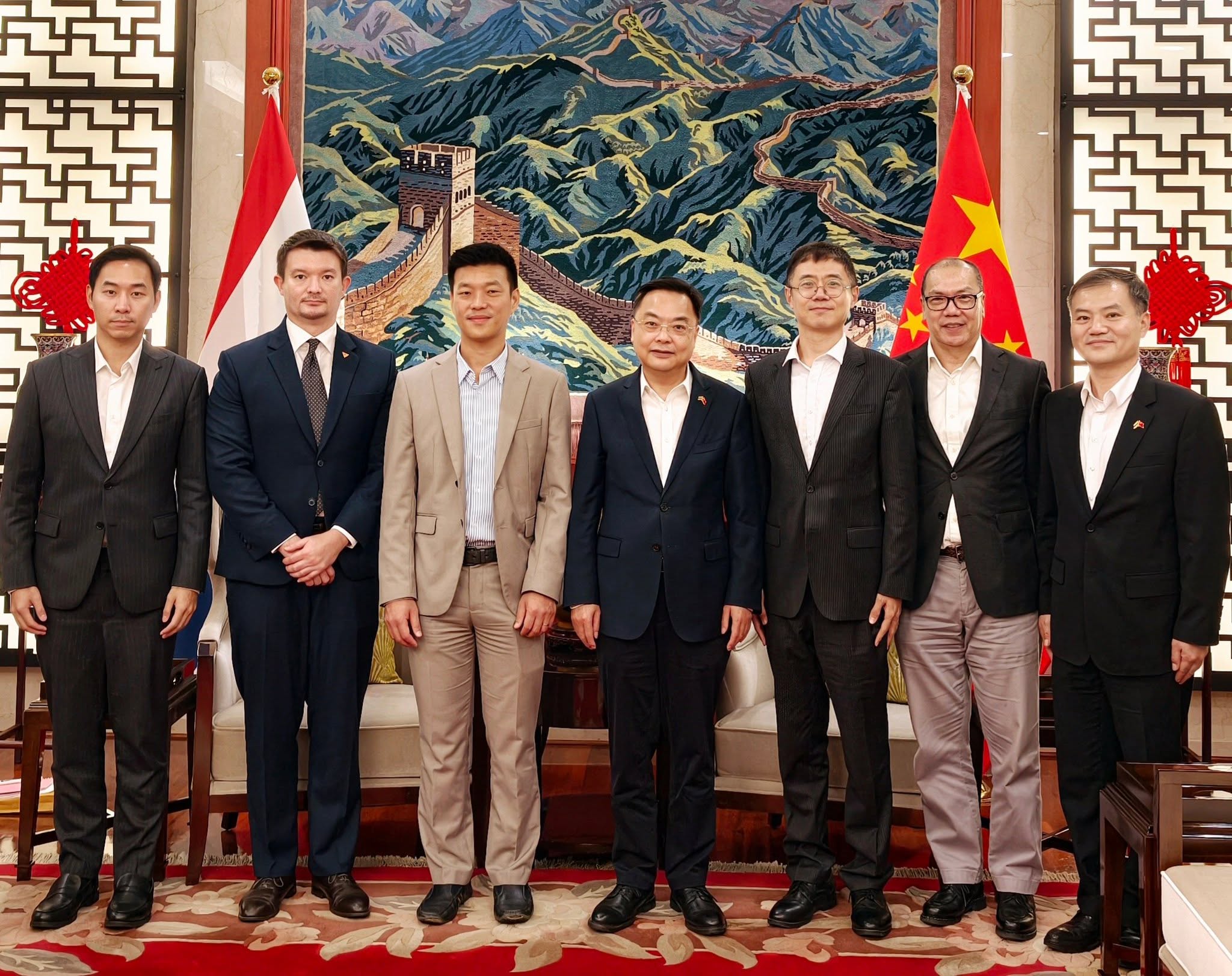
Before the Thai delegation visited China, People’s Party leader Natthaphong Ruengpanyawut and some of the party’s MPs, including Chiang Mai MP Phattarapong Leelaphat, met with China’s Ambassador to Thailand, Zhang Jianwei, to call on China to help address the problem. They also submitted evidence for China’s consideration in the hope that the Chinese government would take action and investigate allegations of Chinese entities’ involvement in toxic mining activities in Myanmar.
Mr. Phattarapong later said in a social media post that the ambassador had assured them he would forward all the evidence and supporting documents to the Chinese government. The party requested an official response from the Chinese government in writing and said it would follow up on the matter closely, he added.
“We, the People’s Party, have submitted a memorandum containing detailed information on this transboundary river pollution to the Chinese Embassy on behalf of the Thai people. China should be provided with clear information so that it can directly address the problem and investigate its real causes. There must be a demonstration of genuine commitment to resolving this matter with its neighbouring countries,” said Mr. Phattarapong.
In a subsequent post published by the Chinese Embassy about the meeting with the opposition representatives, Ambassador Zhang said China fully understood concerns over environmental and public health in the affected river basins. However, he stressed that the issue must be thoroughly examined based on scientific evidence and clearly established responsibilities.
China, he said, is willing to strengthen cooperation on water resource and ecosystem management with the river basin countries. It also supports greater cooperation and communication between Thailand and Myanmar to jointly investigate the issue and resolve it appropriately.
The ambassador also criticised what he described as attempts by some individuals to exploit the issue by stirring up controversy and making what he called baseless accusations and smears against China before the facts had been fully established and responsibility determined.
China firmly opposes such actions, he said, adding that he hoped the People’s Party would maintain an objective and rational stance while continuing to play a constructive role. The Chinese government has yet to issue an official response to the opposition party’s submission of evidence.
The Protests
Amid the apparent lack of action by the governments concerned, anti-toxic river pollution campaigners and environmental advocates have taken steps to draw attention to the issue.
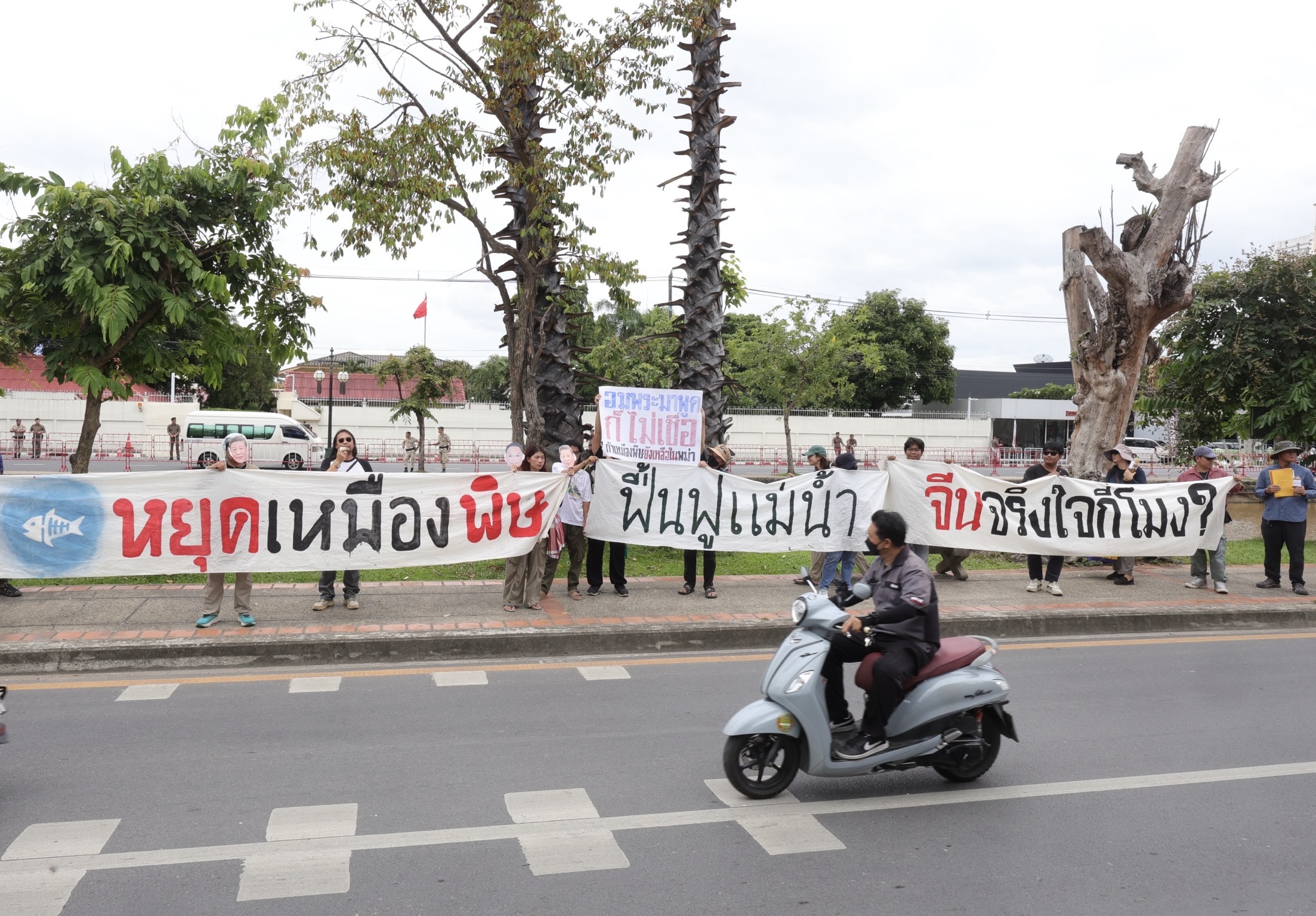
On July 6, about 30 members of the People’s Network for the Protection of the Kok, Ruak, and Mekong Rivers marched to China’s Consulate-General in Chiang Mai, carrying banners bearing messages such as “Stop the Toxic Mines” and “China, How Sincere Are You?”
The group sought to submit an open letter, through Chinese Consul-General Chen Haiping, to Chinese President Xi Jinping, urging the Chinese government to address Chinese investment in rare earth and other critical mineral mining in Myanmar, which campaigners allege has released toxic substances into transboundary rivers, affecting the livelihoods of millions of people across the ASEAN region.
When the protesters arrived, the Consulate-General immediately closed its gates and did not send any representatives to receive the letter. Meanwhile, about 100 Thai police officers, both in uniform and plain clothes, who had been deployed to maintain order outside the consulate, used barricades to block access to the main entrance and attempted to push the protesters back, resulting in clashes that left two protesters injured.
One protester suffered a fractured left arm, while another sustained torn ligaments in the right shoulder and was hospitalised. The incident did not escalate into further violence or injuries. Both protesters were taken to hospital, while the protesters’ lawyers later filed police reports at Muang District Police Station.
“The Chinese Consulate-General’s decision to close its gates demonstrated a lack of sincerity in addressing the problem of transboundary toxic river pollution and contradicted statements previously made by the Chinese Embassy on social media,” said Sayan Khamnueng, director of the Living River Association, who coordinated the campaign.


l The protesters marched to China’s Consulate-General in Chiang Mai on July 6 to demand China take action to address the issue. Photos: Bangkok Tribune
On World Environment Day, the Chinese Embassy posted on social media that the Chinese government has always attached great importance to environmental protection and ecosystem conservation. It said China is committed not only to pursuing green development domestically but also to requiring Chinese enterprises operating overseas to comply with environmental regulations and prioritise environmental protection.
The embassy also stated that Chinese state-owned enterprises would never sacrifice the local environment for economic gain and that any violations would be dealt with seriously in accordance with the law.
Mr. Sayan said the network’s open letter made clear that Thai people did not want rivers contaminated by mining operations backed by Chinese investment, whether in Myanmar, Laos, or elsewhere in the ASEAN region. The letter also called on China to demonstrate its sincerity by living up to its principle of “drinking water from the same river.”
“If there is genuine sincerity on this issue and a thorough investigation into the mineral supply chains leading to China is conducted, we believe the Chinese government can trace the origin of these minerals, identify the companies involved, determine whether their operations are legal or illegal, and take regulatory action to prevent companies from operating without regard for environmental impacts,” he said.
“The Chinese government is capable of doing all this. It is enthusiastic about cracking down on scam operations abroad because they directly affect the interests of Chinese citizens. But it appears to ignore the problem of toxic contamination in the rivers because China benefits from it. It does not seem to care if people in other countries suffer or even die from these dangerous pollutants,” Mr. Sayan said.
According to the network, six rivers have been affected by rare earth mining linked to Chinese investment. In addition to the four rivers that have received the most public attention, the Salween River in Myanmar and the Kraburi River in Thailand’s Ranong province, which borders Myanmar, have also been affected.
The following day, Mr. Sayan filed a complaint with the National Human Rights Commission (NHRC), urging it to investigate the police’s use of force against protesters outside China’s Consulate-General in Chiang Mai.
The group also called for legal action against those responsible, appropriate remedies for the injured protesters, and engagement by the NHRC with both the Thai and Chinese governments to address the issue of transboundary river pollution affecting major rivers in the ASEAN region.


l The Thai NGO-COD staged a protest in front of the Chinese Embassy in Bangkok on July 8. Photos courtesy of Thai NGO-COD
The incident also prompted the Thai NGO Coordinating Committee on Development (Thai NGO-COD), one of Thailand’s largest civil society umbrella organisations, to issue a statement condemning the use of force against the protesters and calling on the authorities to take appropriate action.
On July 8, the group staged another protest outside the Chinese Embassy in Bangkok, condemning the violence that left protesters injured in Chiang Mai and demanding that both the Thai and Chinese governments accept responsibility for the severe river pollution.
The group also escalated its demands, calling for greater transparency about what it described as the structural causes of the problem, which it said the Chinese government could no longer deny, and urging the governments concerned to confront the true environmental costs of development.
Before PM Anutin departed for China, the group issued another statement urging him to raise the issue directly with Chinese leaders and press China to take responsibility for the consequences of business activities that it said “oppress and trample upon the people of Myanmar and Thailand.”
The appeal, however, was met with silence, as the Prime Minister did not raise the issue during his visit.

Indie • in-depth online news agency
to “bridge the gap” and “connect the dots” with critical and constructive minds on development and environmental policies in Thailand and the Mekong region; to deliver meaningful messages and create the big picture critical to public understanding and decision-making, thus truly being the public’s critical voice